I want to say flawlessly but I am sure there was something I did not perfectly.
Whatever. I landed and I am blown away by my new work environment. #IWorkForGM now.
It’s really awesome!

I want to say flawlessly but I am sure there was something I did not perfectly.
Whatever. I landed and I am blown away by my new work environment. #IWorkForGM now.
It’s really awesome!
I took two moonshots. One made escape velocity, hoping the trajectory holds. A landing would be peak.
You could say my life needs an LS swap.
That is all.
A long time ago, a car maker made an engine, and it was a good little engine. It was designed for transverse applications, but it was so good, they put it in a longitudinal applications, too. That required some massaging of the oil pan, and it lost about 20% of its oil capacity.
The good little engine came with a requirement to use synthetic oil because it was equipped with a very good little turbocharger, which got very hot. It was very important to use an oil that could handle the heat, especially because there was less oil that there was originally intended to be, and it was before coolant afterrun pumps were really a thing.
The American dealer network wasn’t too keen on the cost of synthetic oil, so they put petroleum-based oils (dino) into the good little engines during routine maintenance. A lot of good little engines were run very enthusiastically by their owners and put out a lot of heat. The good little engines did not have coolant afterrun pumps, so the very good little turbochargers cooked that oil and made coffee grounds out of it when the engines were shut down hot. The coffee grounds moved into the oil pan on startup and plugged up the oil pickups which starved the bearings and lot of owners became big mad.
Some lawyers also became big mad and made a class action lawsuit of out it. But it was really hard to argue about because the coffee grounds didn’t fit the normal ways engines failed. There was no sludge.
So the lawyers asked around and finally it all ended up in my lap and I got to explain to the world about the difference between thermal oxidative stress that leads to sludging, and thermal stress in the absence of oxygen that leads to coking. And coking is what makes little coffee grounds that clog up oil pickups. And when confronted with that fact, the car maker folded and granted relief to a lot of owners who were big mad and a really really long warranty extension to any owner that had ever had an oil change at a dealership and had the papers to prove it.
The same car maker had a Head of Internal Combustion Technology who tried to tell me to my face that they did not have PCV issues. I was big mad about something else he had said in that meeting, so I offered to bring my intercooler (from one of his engines) in and turn it out on his desk. In front of his team. Somehow, I did not get fired for that.
Naturally, there was a spreadsheet involved.
My goal was to max out reliability and moderate cost.
I looked at a new FA20 short block, but the passenger side head was compromised. Then I thought FA20 long block, but that was basically good money after bad. I never complained about the torque dip as I rarely spent any time in it, but this just seemed like a MEH idea. Whole used engine, nope, because it would be just another ticking time bomb with me driving it. I also thought about doing an FA22 (FA24 short block/FA20 heads), but machine shop time…. too much stress. So also no.
Then an FA24 with 15K on it showed up. Hello and nice to meet you. Thank you to the friend who linked me to it!
The total for the swap is not small money, but it is also not big money, considering what engine swaps can cost you. The main thing is that you can run the FA24 on the FA20 ECU and wiring harness. This is a very non-trivial savings!
Engine – $6K
Assorted fasteners and gaskets (dealer/Amazon) – $150
Verus ECU bracket – $70
Hachi harness bits – $200
Tomei Joint Pipe – $235
I’ve also gone ahead and pre-ordered the Formula Delta oil pan as I do track the little beastie. If I end up paying for tuning, figure another $400 for that. I also upgraded to the Verus Forged clutch fork. If one person was the rock star here, it was the shipping clerk at Verus. They were on it – both orders shipped silly fast.
I usually make my own connectors, but I’m glad I ordered the Hachi bits. Very nicely made, labeled professionally, and I got to support a tiny aftermarket dude who uses the Farmington Hills font. If you are local to SE Michigan, you know what I am talking about.
The decision to upgrade the exhaust joint pipe came after discussion with a colleague who has experience in that sort of thing (Detroit peeps rock. Seriously). Rather than fool with the manifold (I did get a Tomei UEL catless with the engine) and risk fitment issues with the Formula Delta pan, I opted to go for a stock manifold. The factory exhaust manifold has a cat which is considerably larger than the FA20 unit, so good there, but the FA20 joint pipe (right after the cat) is … not big … and is a known bottleneck in the exhaust. The Tomei unit is straight through 60mm, over the 54mm weirdly internally shaped stock one. That will mitigate any downstream issues. It drones pretty badly at idle with the stock one, hopefully that goes away because it is BAD.
I kept the FA20 AC compressor (never unhooked it, just bolted it back to the FA24 which avoided refrigerant loss) and the FA20 alternator and bracket. The AC compressor rear mounting buss was there and threaded, just unused. The alternator bracket is not going anywhere with only three of four bolts in it.
The swap was the lowest drama swap I’ve ever done aside from a dead-factory one. That includes several VW swaps Mk1-Mk4, where there is no Body Control Module to deal with. Honestly, it was as easy as a stock Mk1 swap. There was literally nothing to do except forget to plug in the High Pressure Fuel Pump and wonder why it wasn’t running well. Once that was done, it fired up and went into idle calibration perfectly. If I help with another car, I think I could do this in a weekend, possibly even in a single day. If I subtract the teardown of the FA20 and my missed points (the clutch fork needs to be all the way on the ball mount, HPFP connector, missing hardware, yadda yadda…), it could definitely be done in a longish day.
I’ll be tuning with an OpenFlashPerformance tool with support from a friend who actually knows what they are doing to get it on the road safely.
Yes, you can buy horsepower. I guess I have to make a new sticker. No more torque dip.
This is what a spun bearing looks like. The bearing has slipped in the gap and worn itself to nothing. Damage to crank and to big end bore.
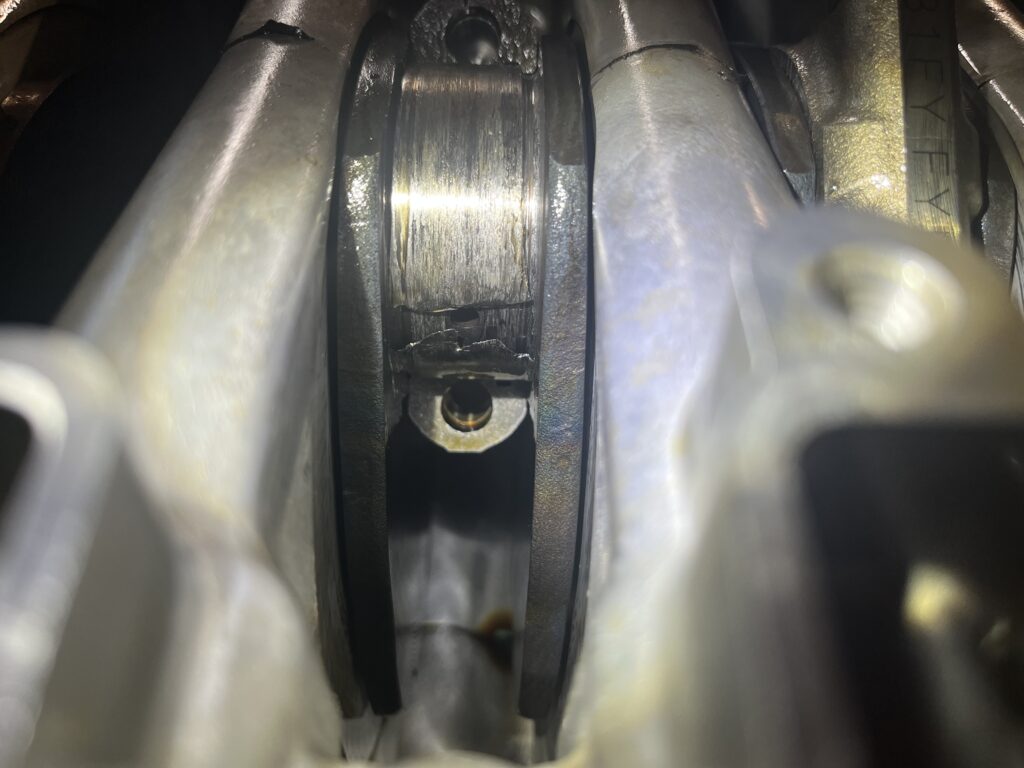
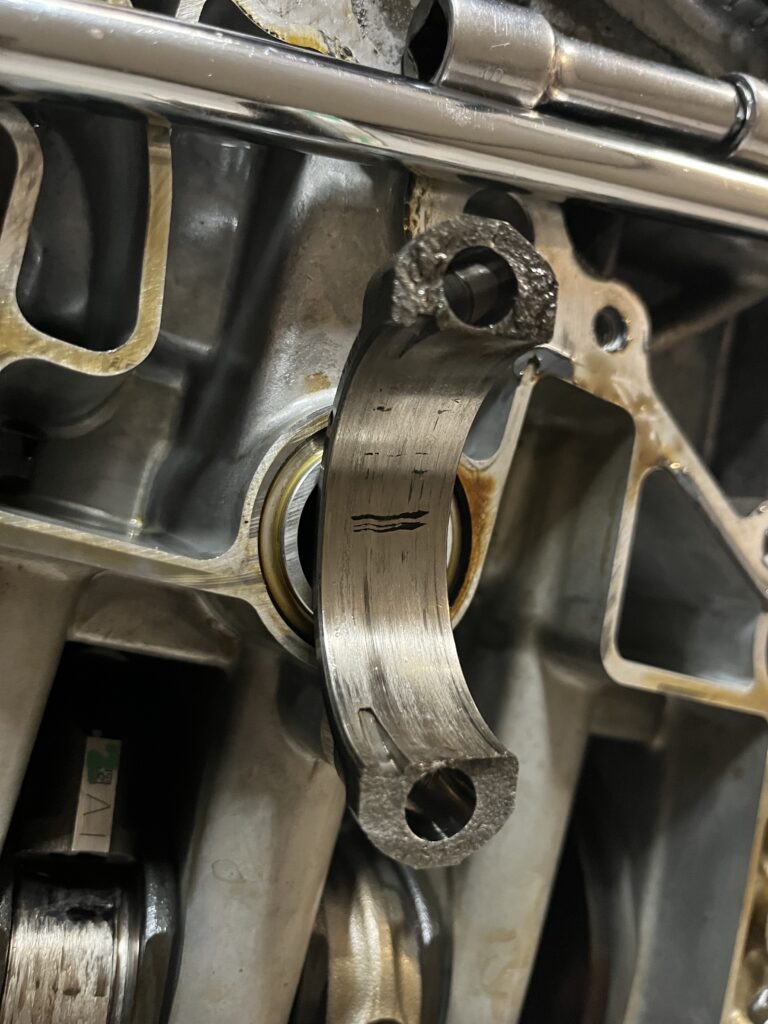
Honestly, this is really bad, and it’s kind of a surprise that the rod did not try to move about the cabin. Props to Subaru for having an engine that did not explode.
Tomorrow, will start on heads to check the cam journals. Then, decision time.
#2 is not having it. #1 and #4 are fine, #3 has a little side-to-side slop, but #2? That is, as the kids these day say, a real banger.