Archives

All posts by atomicalex

The  landscape around the Hotel Savoia (which we highly recommend) is positively lunar as the sun rises. We are greeted by fog burning off outside, and a surprise guest inside – a fully-dressed Harley has joined us in the garage overnight. The garage functions as a ski rack in the winter time, when the mountains are covered with white stuff and skiers descend on them like flies on pigs. The openness to motorcycle tourism came about as the thousands of small guesthouses in the Alps discovered that the “off season” can also be profitable – riders flock to the passes as long as they are open, and with open wallets. Breakfast at the Savoia is well-covered, and we can’t say enough about this overnight, it will define accomodations for us for the remainder of the trip.

DSCN4068

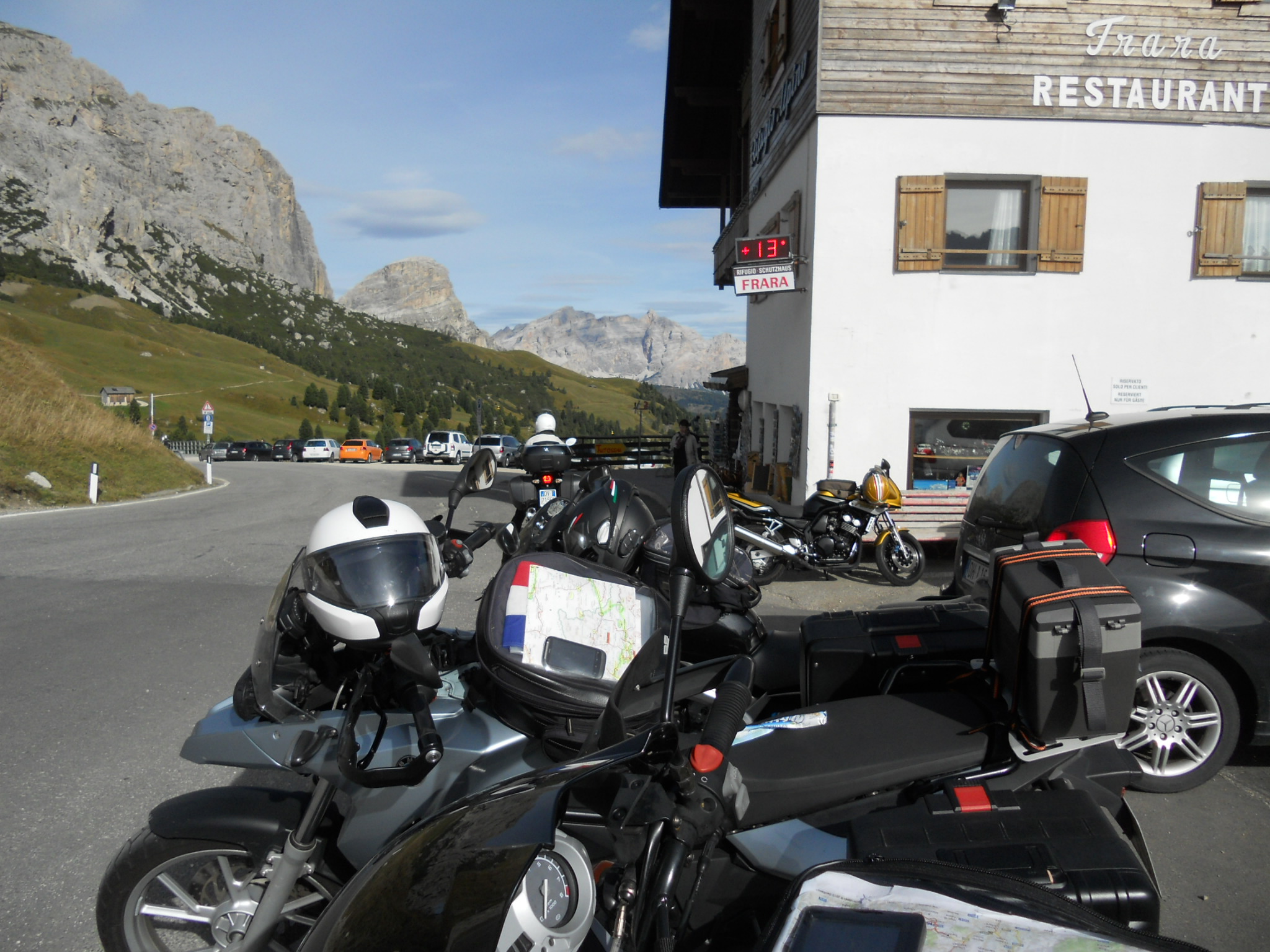
We head out on SR48 and rejoin SS242 to go back over Passo Sella, this time with less traffic. The mountain views are breathtaking and we spend plenty of time checking out the peaks that bring so much fame to Sella.

DSCN4069

DSCN4070

DSCN4073

From Sella, we stay on the SS242 west to Ponte Gardena, where we pick up SS12 heading south to Bolzano. We join SS22 and find the three guys from the train and cows – some honking and waving and total shock that we actually did meet up go on. West of Bolzano, we pick up SS42 to Passo Mendola.  The approach to Passo Mendola is one of the most striking stretches we ride, with a stunning view of the valley below. For a long stretch, the narrow road clings to the side of the rockface and the mood is entirely surreal. The final group of tornante bring us to the town of Roen at the top of the pass, where we stop for coffee and to admire the views.

DSCN4075

DSCN4077

In Fondo, we tank up (250.3kms, 750,4km total) and are berated by a Bavarian Ducatisto who wants us to know that there is no passing in Italy. Perhaps he should have told the Italians? We ask him to speak German as his dialect is so thick. We pick up SS238 north to Merano crossing the Passo Palade. I expect more from Merano, the spa no connisseur of spas can miss, but it is quickly past and we are into a transit stage that will take us up and west on SS38 to Prato. We have been riding parts of the Italian Wine Road since Bolzano, admiring the fruit orchards that line the road to within two meters of the fog line. We stop for a quick lunch, then ride on  with SS40 and SS41 (becomes 28) to the Ofenpass, where it is actually too warm to remain fully dressed.

DSCN4079

We finish the day at the top of the Flüelapass, where we discover Swiss prices. The Flüela Hospiz is as old as the pass and offers timely accomodations. This is a euphemism for out-of-date – we get a room with “washing possibility” – a sink – for 87€ each, including breakfast. Aside from the price and the warning to fully unpack the bikes and bring everything inside for the night, it is uneventful. Dinner is a welcome mix of traditional swiss Röstis and salad.

DSCN4082 DSCN4084

I suppose it would be pointful to review the equipment.

Bike: one fully-factory-farkled 2004 BMW F650GS, 66K kms on the frame, ~25K on the 2006 GS engine purchased from ebay and installed a month earlier

Luggage: One Held tank bag with rain cover, three small Streetline drybags, and two BMW Vario boxes, one extended

Clothes: Three sets of functional liners – one warm polypro (Anzoni), one light polypro (Maier, star of the trip!), and one nylon running set with no leg zips (Nike/Alex). Six pair assorted socks, nine pair nylon underwear, six tshirts, one pair jeans, two fleeces, one pair shorts, one pair Nike Free original, one pair pyjama bottoms, one neoprene vest

Gear: Hein Gericke Grace GoreTex jacket and pants, HG City gloves, Louis silk glove liners, Polo Road warm gloves, Oxford hi-vis vest, Dainese GoreTex ladies boots, HJC RPHA-Max helmet

Electronics: Garmin nüvi 1435 navigation unit, GoPro Hero3 Silver camera, BlackBerry Torch smartphone, Nikon CoolPix S3000 camera, Midland BTNext commset, Hexcode GS911 interface, LG phablet thingy, assorted USB cables and chargers

Comments: The bike was great, only issue was a siezed centerstand pivot that caused a tipover and resulted in a seat tear. The luggage was just right. Too many socks, should have gone for fewer pairs but all synthetic. The Falke ski socks were perfect, three pair would have done it. More lighter-weight tshirts would have been better – the skinny hipster cap sleeve ts were the best ones. I could have gone without the heavy polypros, a second pair of the Maier set is being sought out now. Very light weight meant very washable and dry within hours. This alone could cut the space required quite a bit. The jeans were a must-have. Not having to wash underwear was nice.

The GoreTex outer gear worked perfectly. Absolutely the best decision of the planning phase was to go with textile over leather. Flexibility was fantastic thanks to the easily removeable liners. The (old) City gloves paired with the silk liners made the normal cold-weather gloves unnecessary. Even in heavy rain.

The Garmin nüvi unit worked (and continues to work) well, even for motorbiking. The routes were developed in BaseCamp and uploaded to a microSD card in the device, then installed as needed. One issue was identified with routes having multiple loops from a single point, the unit would attempt to shorten the route by cutting out loops. This should be minded by users. The GoPro (helmet-mounted) produced good, if not publishable, videos, due to the rider talking too much in her helmet. Thankfully, the GS911 and little LG phablet were not required, but took up so little space that it would be silly not to bring them. The BlackBerry had connectivity in nearly every place we went, allowing at a minimum email and BlackBerry Messenger communication. The little Nikon produced characteristically good pictures in all light levels. The BTNext unit was unused.

Overall comment would be to refine the clothing packing and the tool packing. I made a custom tool roll to pack only the tools I felt would be useful, but even this was likely too much. In a less redneck bike (see swapped motor above), I would be much more comfortable traveling with fewer tools. More GoPro locations will be explored.

If I’d guessed that I would end up sleeping on top of the Alps at one point, I would have never believed myself.

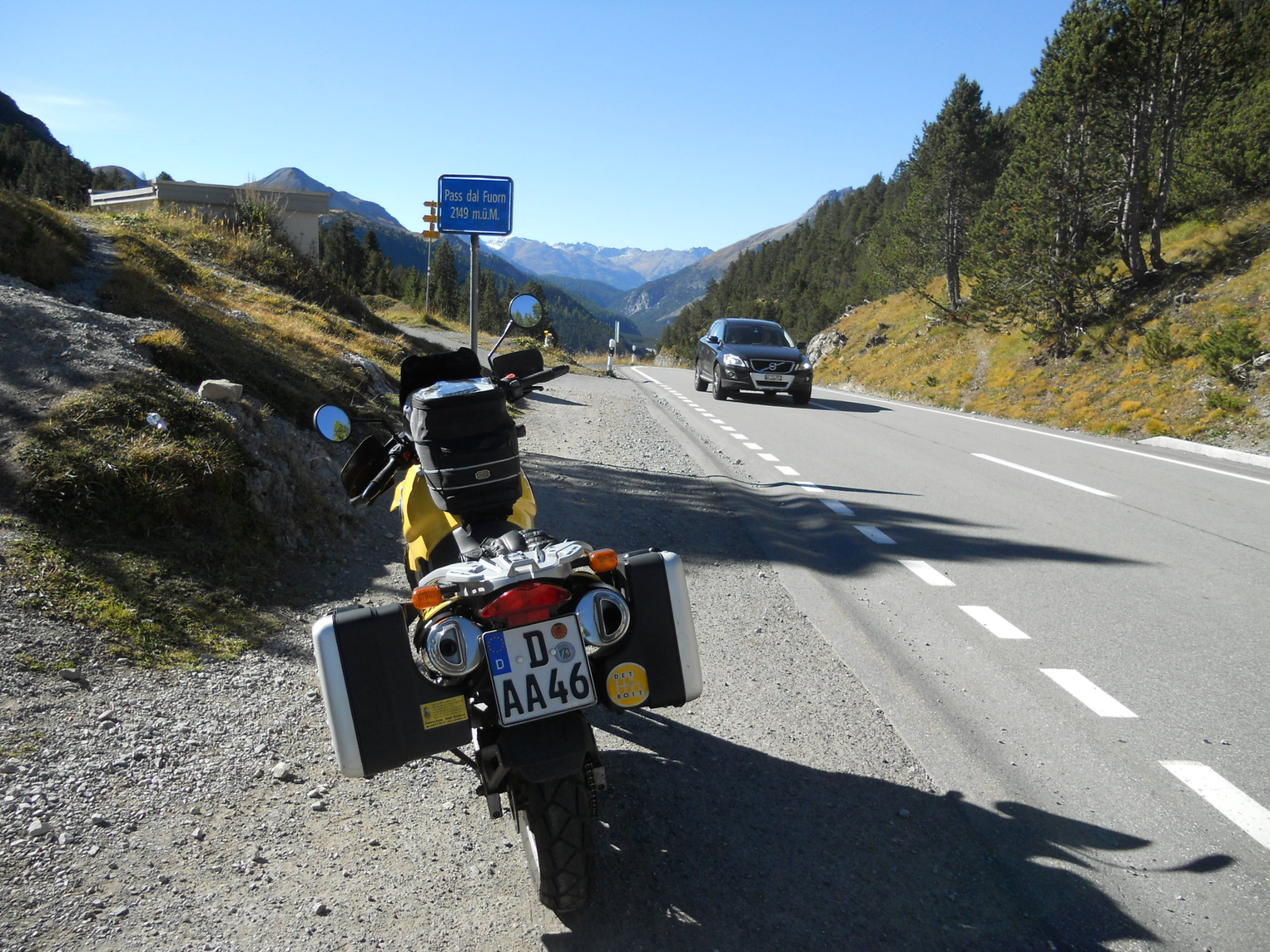
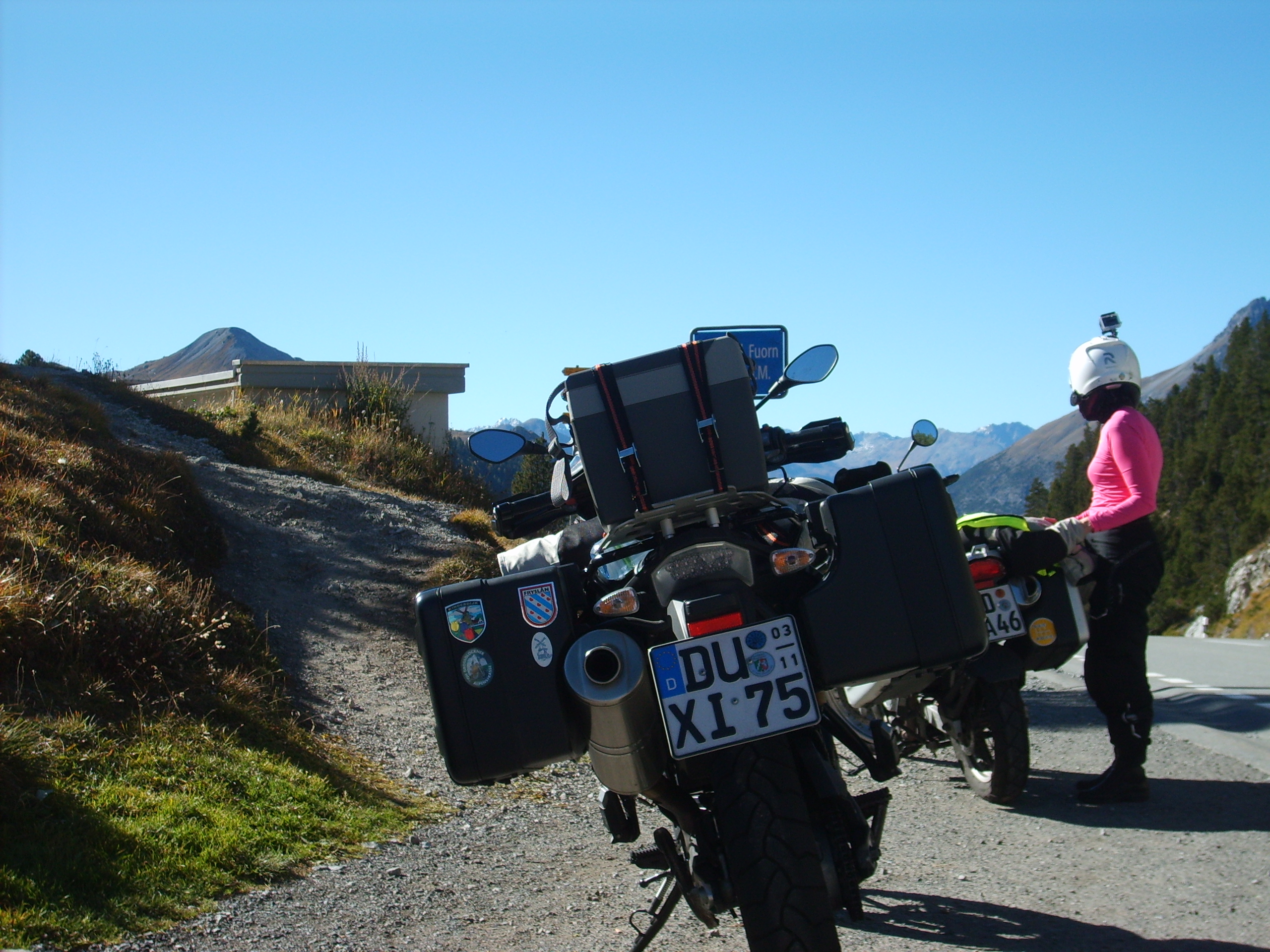
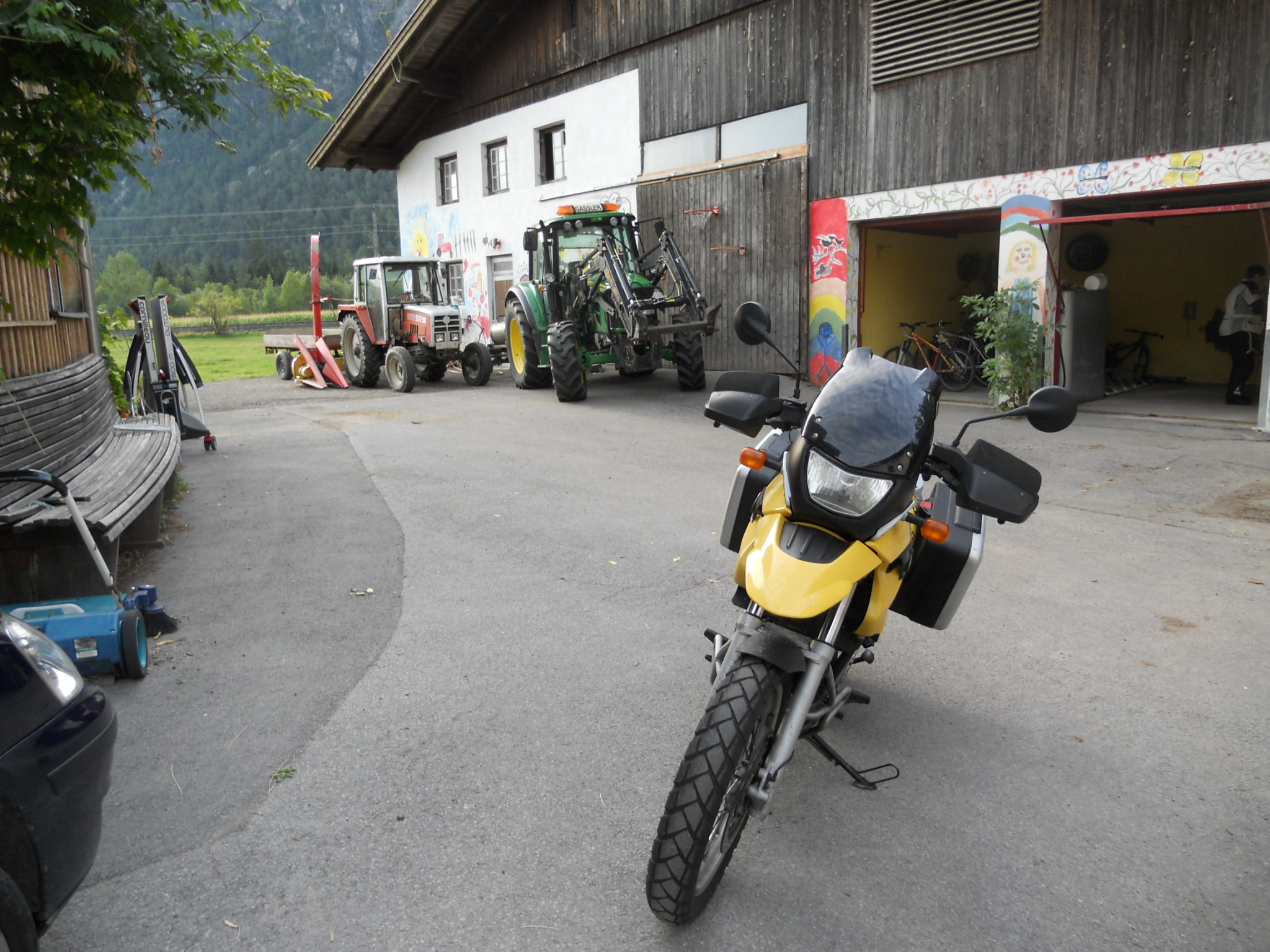
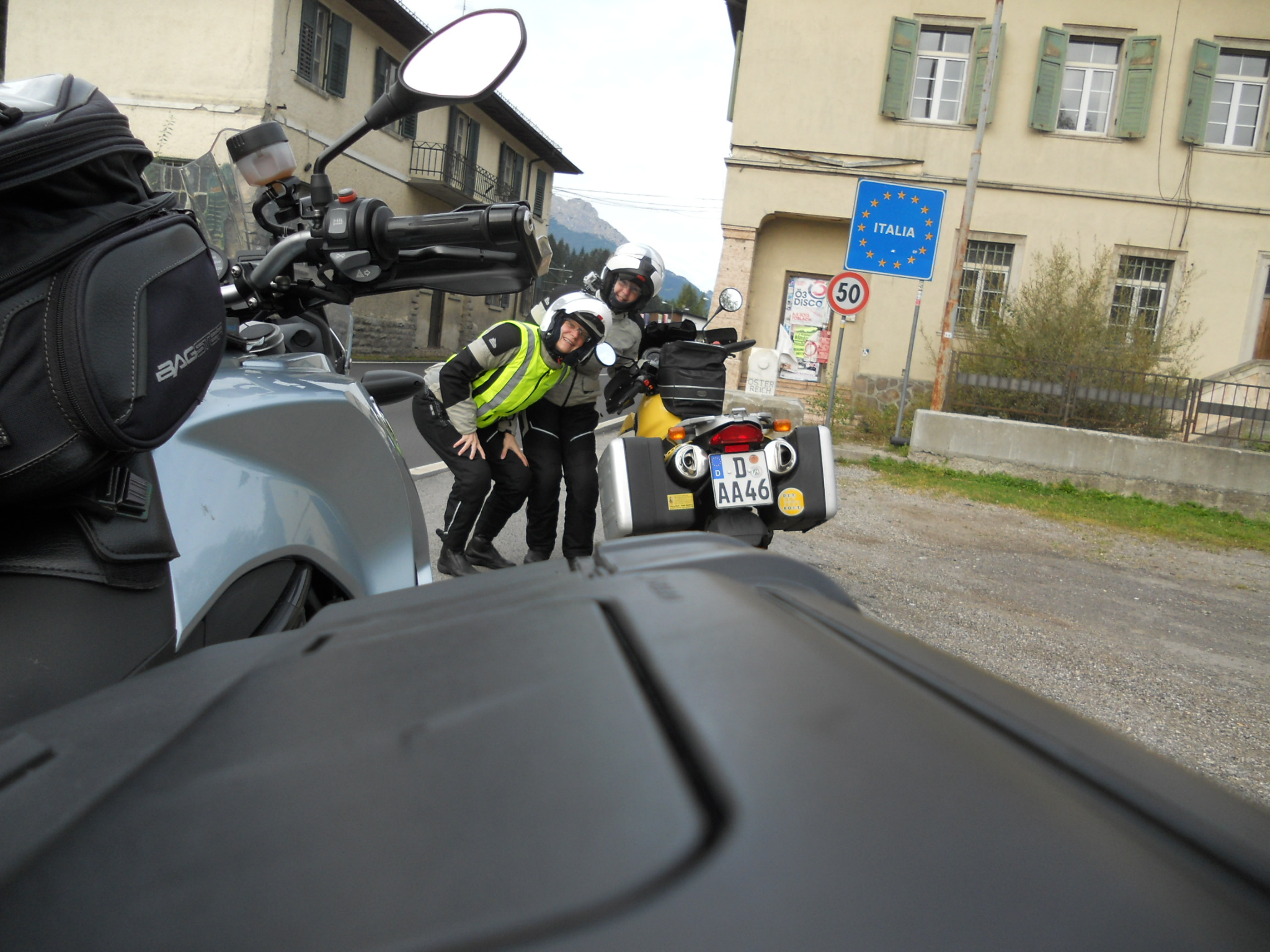
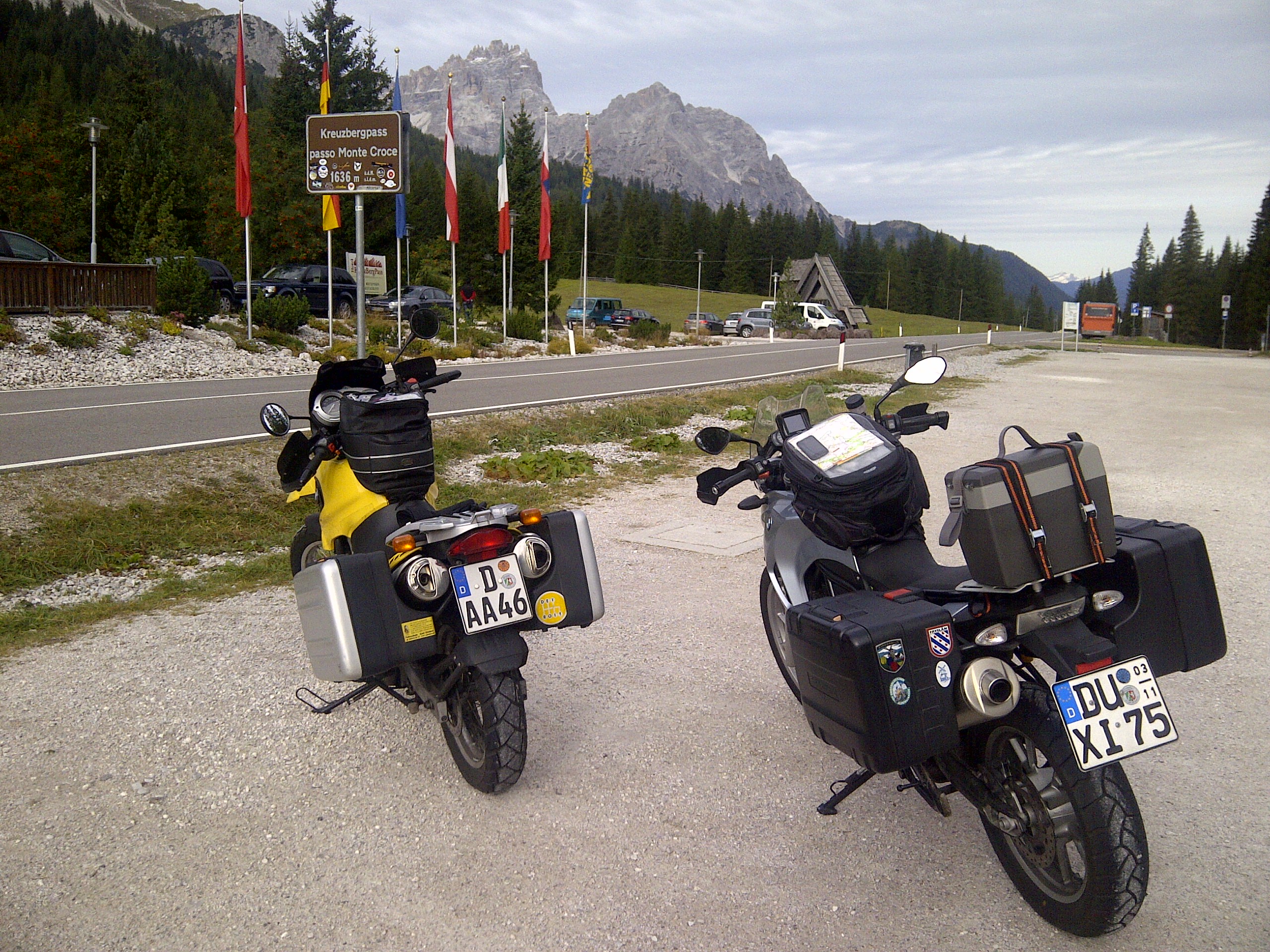
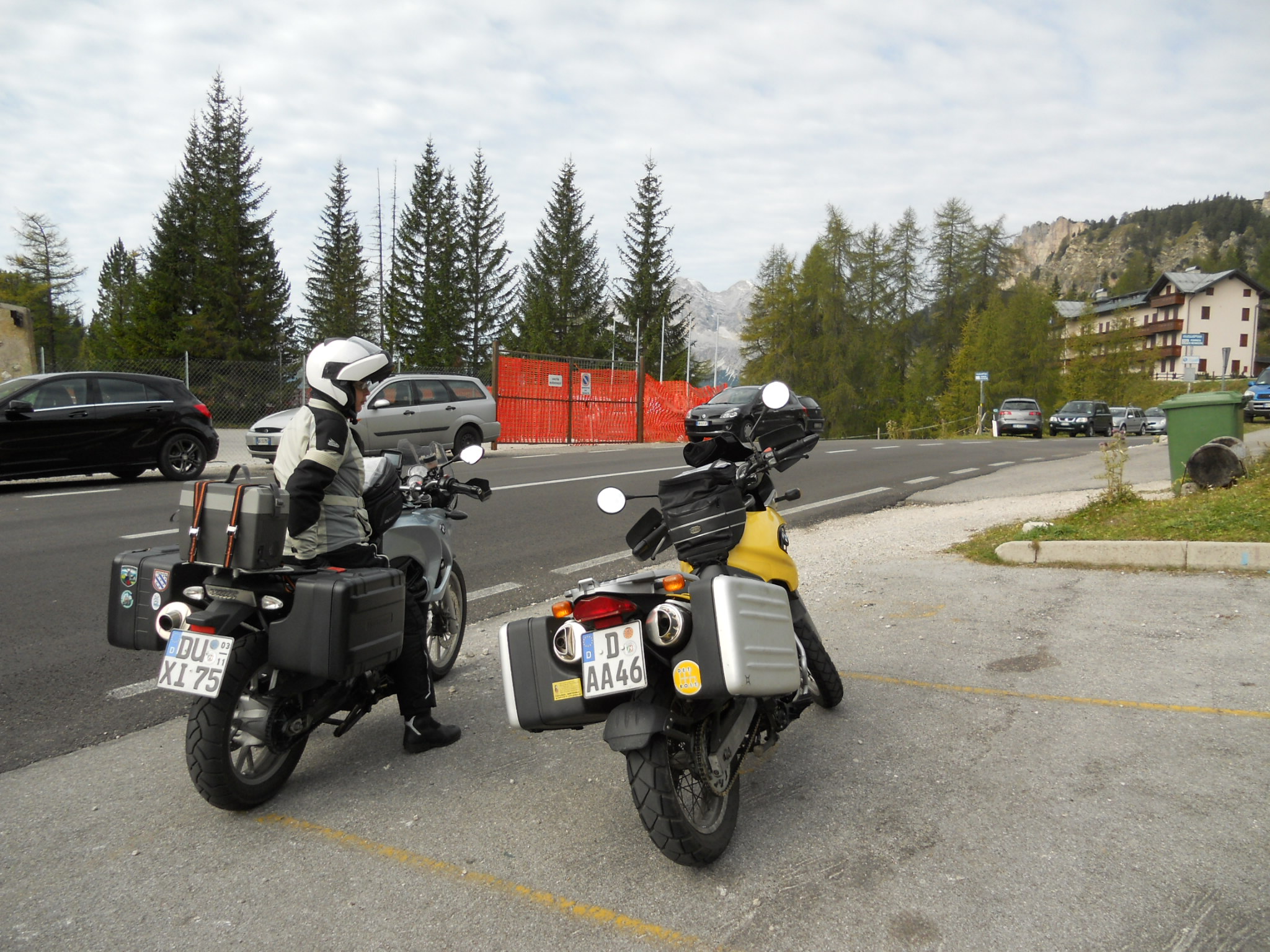
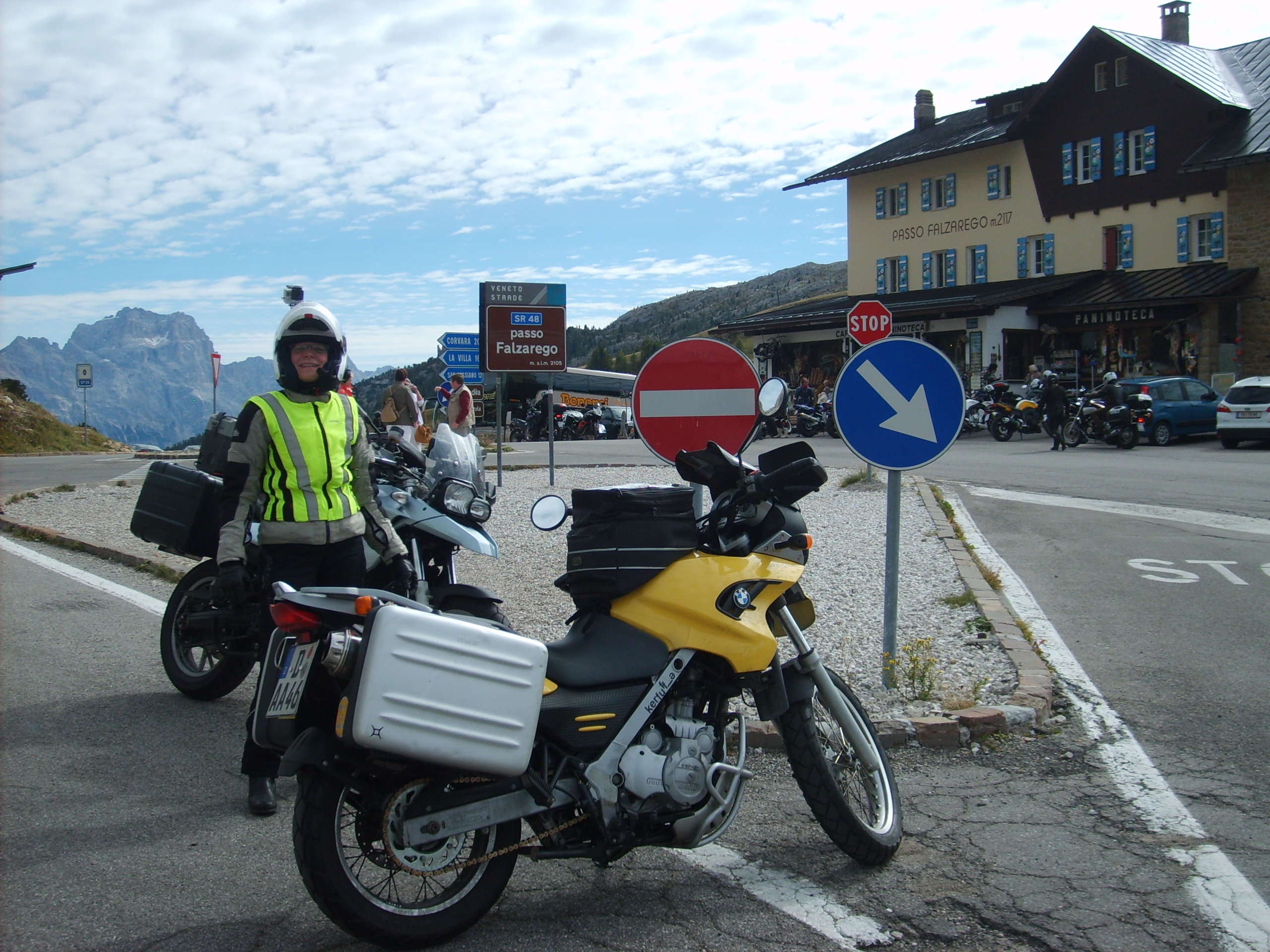
The sunrise in Linz is beautiful. Tucked into a mountain valley, we watch the sun fall over the farmyard prior to taking off from our feathery nest. We head west on the 100 toward San Candido, and in the process beginning a day that would end with nine passes surmounted. We cross into Italy, and on the Stata Stradale 52 (SS52),  meet the first pass of the day – the Kreuzberg Pass. For the most part, a basic pass that is surmounted without event. Turning off onto Strada Provinciale 532 (SP532), we ride over the Passo San Antonio and, on Strada Regionale 48 (SR48), the Passo Tre Croci without stopping – nothing to stop for, as the signs are almost invisible and there are no souvenier huts to buy stickers at. Yes, we collect stickers for every pass we can get them for. The fun really starts further along SR48 with the Passo di Falzarego, where we photobomb a bunch of Swiss guys  trying to take a group shot at the pass sign.

DSCN4023

DSCN4020

DSCN4027

IMG-20130922-00651

DSCN4030

DSCN4035

From Falzarego, we head west on the north side of the Marmolade Group, to better see the peaks. Stunning from the road, for sure. We have our first experience with Italian fuel stations, which are not open normal hours and require use of an automat. 252,3kms for a total of 500,1kms. Figuring that out is so exhausting that we have to sit down and eat lunch. We turn south on SR203, then onto SP641. Next up is Passo Fedaia, with a beautiful view of a Stausee (retention lake) high up in the middle of the group. From Fedaia, we briefly rejoin SR48 and enter the venerable Sella Group on SR242, and meet the first real traffic of the trip.

DSCN4039

The Sella Group offers some of the most profound scenery of the entire trip. The terrain varies from gently rolling meadows to Martian landscapes. The first ascent is to Passo di Sella (Sellajoch), and is miserable with tourist busses. The traffic is very heavy and very unfun. When we halt at the top, we wait for a gap in busses before beginning the descent. We ride the rest of the Sella circuit clockwise, turning onto SS243 to ride through the Grödner Joch (Passo di Gardena), where we encounter a group of elderly tourists with an endless parade of questions, starting with “Why do your motorcycles have BMW stickers on them?”, “Are those real BMWs?”, “Did you ride those here all by yourselves?” and continuing on. After a few more, I inform the small crowd that all info on the bikes is available at their local BMW dealer.

DSCN4044

DSCN4048

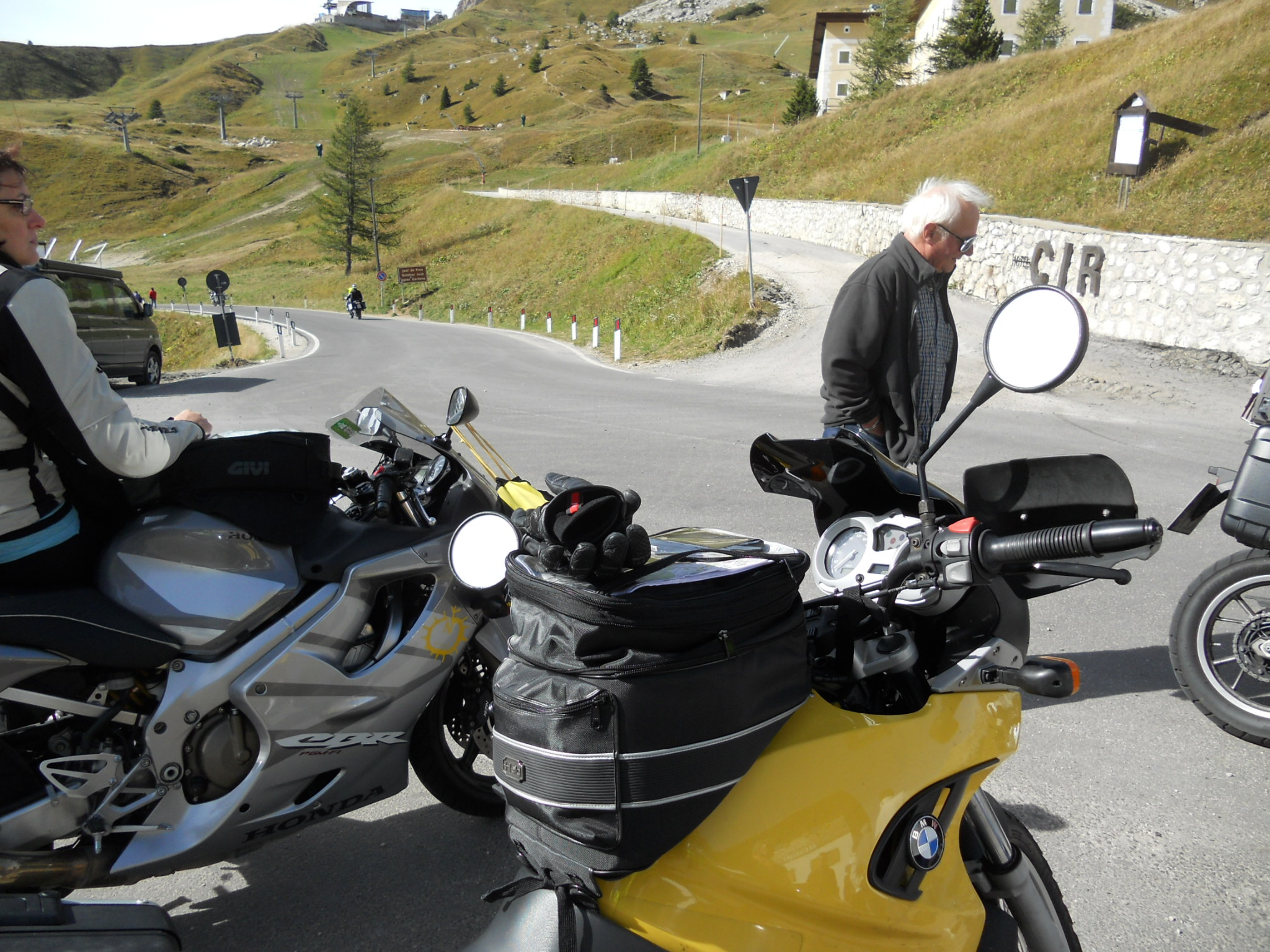
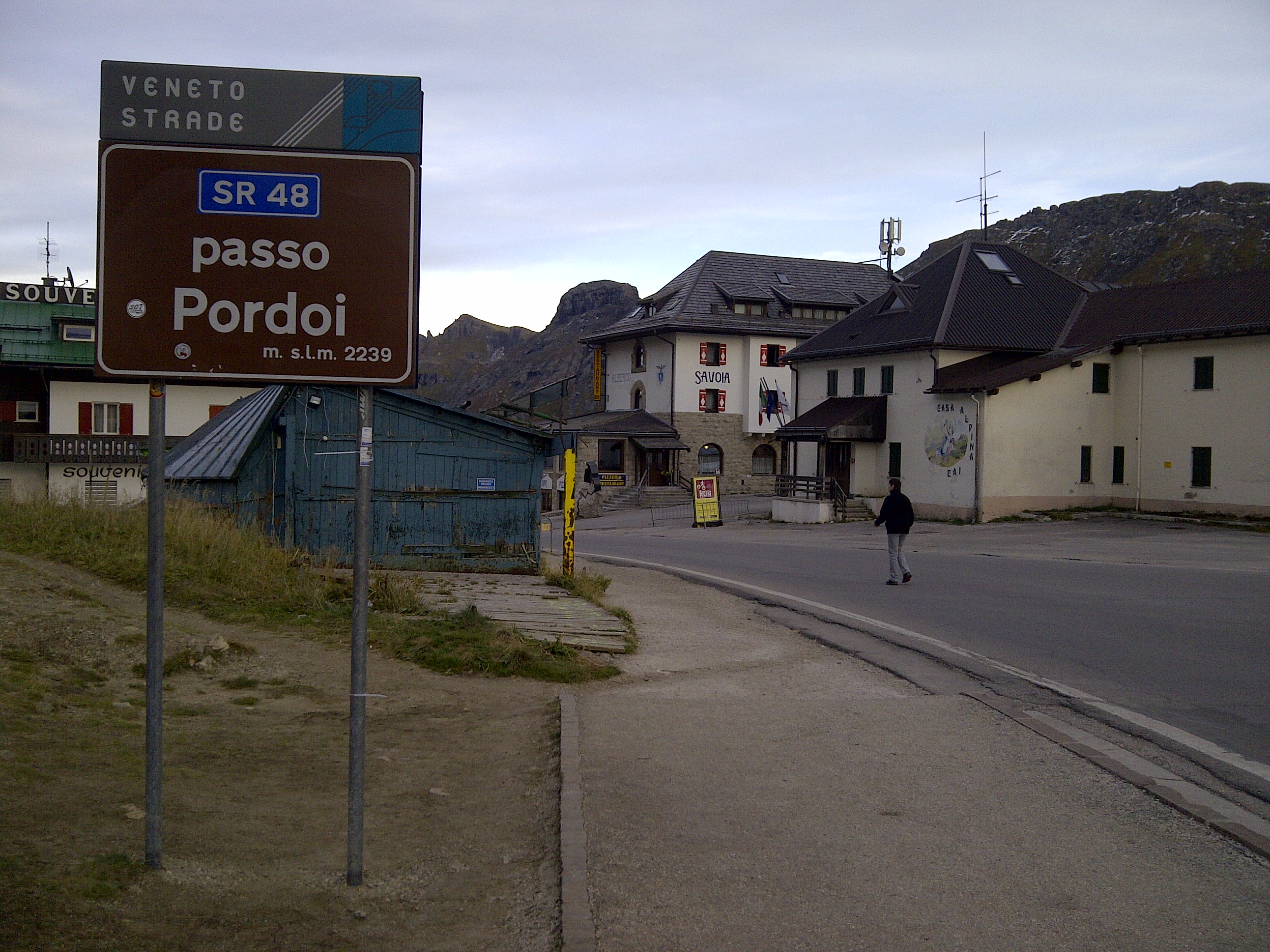
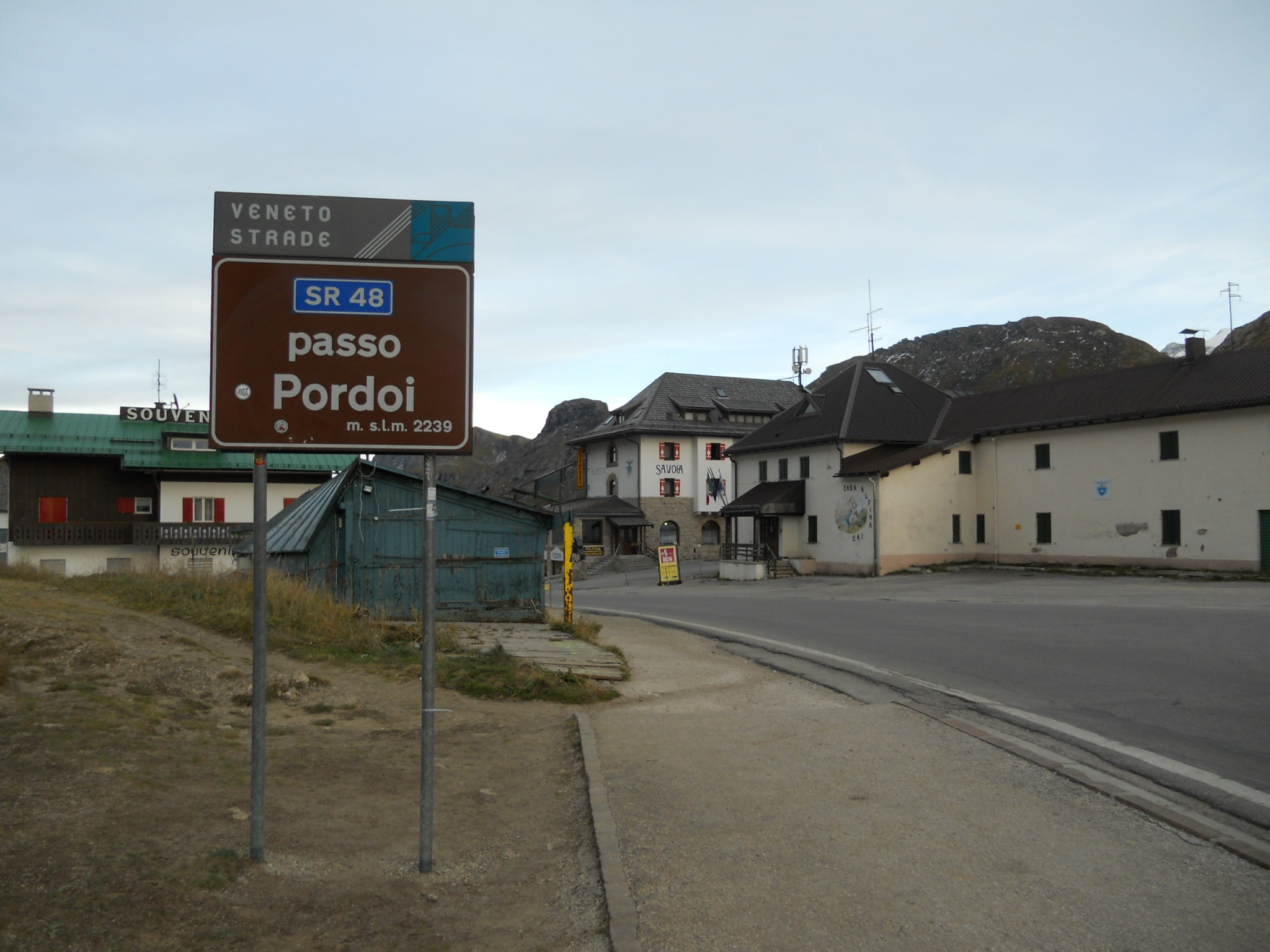
We ride on to SP244 over the Passo Campolongo (nothing to stop for), and finish the day on SR48 on top of Passo Pordoi after a quick 33 tornante ascent that counts as one of the highlights of the trip due to the absence of traffic, the road character, and the unusually curious cows penned at the roadside. We hole up in the Hotel Savoia for 50€ a head including breakfast, garage, and a four-course dinner. We highly recommend this hotel. Excellent service, food, and accessibility.

IMG-20130922-00660

DSCN4063

Two chicks, two F650s, and two big dreams. Katherine, on an F650GSa single with an ebay engine that was installed a whole three weeks before the start, and Sabine, on a F650GS twin that she has owned from new, off to ride the Alps in a nine-day pass-bagging adventure that would check off entire bucket lists for some people. What started as a wish to see the Sella Group (Sabine) and a burning desire to run Stelvio (Katherine) ballooned into a trip that eventually included 2600kms, the weirdest train ride ever, and 36 Alpine passes. The trip actually started on Day 0, when we boarded the DeutscheBahn AutoZug in Düsseldorf with 37.4 miles on the trip odometer. Lined up at 20.00 or so, we were in a group of roughly 40 motorcyclists and 30 cars bound for München. The train also included a section going to Innsbruck – the vehicle carriers were separated in Munich so that the Innsbruck-bound passengers would not have to wait for unloading. Among the cars going to Munich were a group of British Elise enthusiasts who we would see and speak with again, and a group of three riders who we agreed (with a smile) to meet in Bolzano, as we were all headed there at one point in our journeys. Funny how everyone had similar itineraries… Düsseldorf-20130920-00638

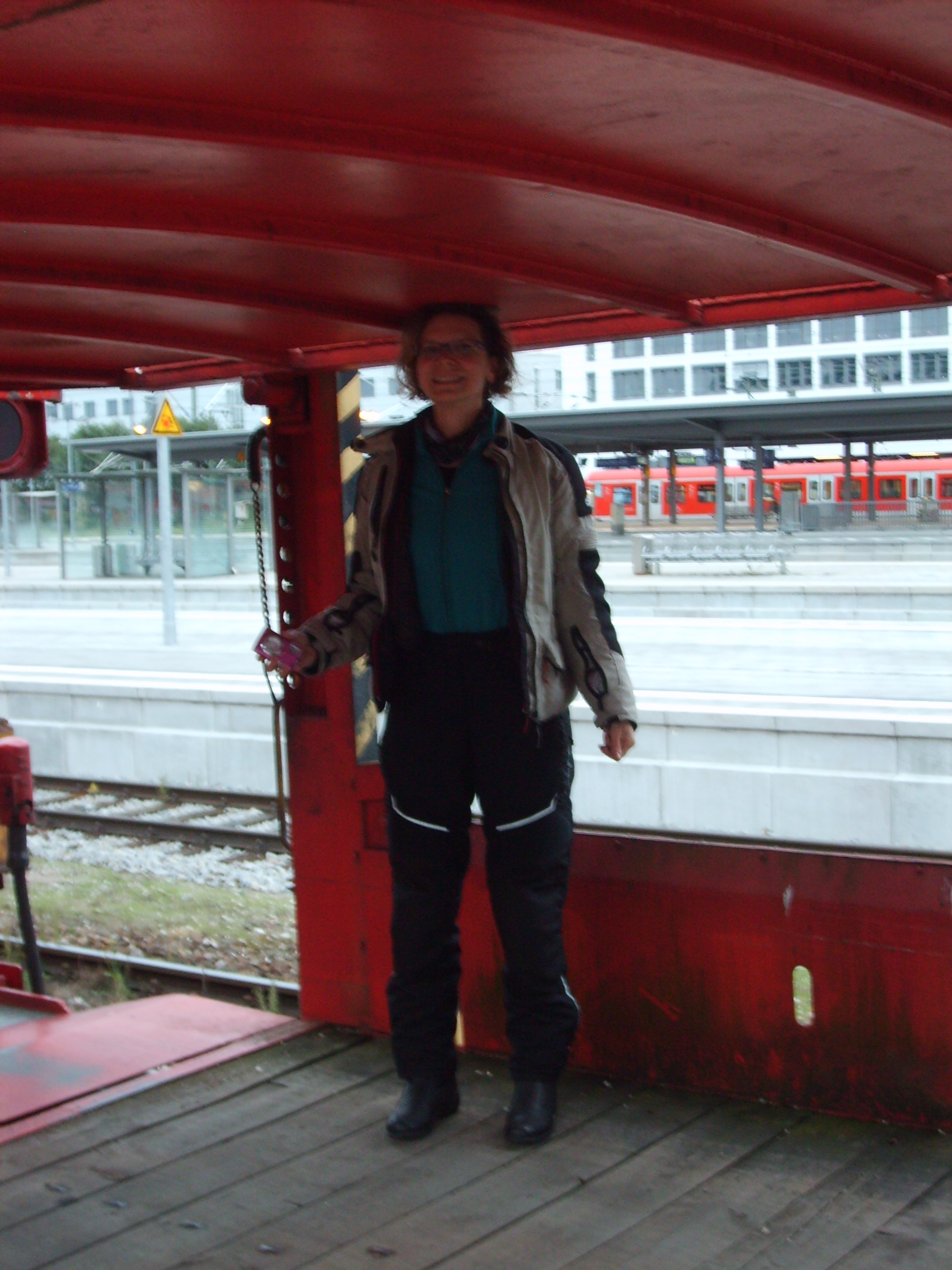
The AutoZug is not for the faint of heart. The carriers are two-level and motorbikes live on the lower floor. The clearance is 1.56m, shorter than me. Motorcyclists attach tiedown straps to prefered points on their bikes, ride them in, and ride out after the trip. I rode in with my chin bar firmly pressed to my tank bag, and was warned to remove my GoPro from my helmet. Rats, I really wanted that on video, too. The DB crew moved in and secured the bikes with cleats front and rear and tiedowns. DSCN3947 IMG-20130921-00644 DSCN3939

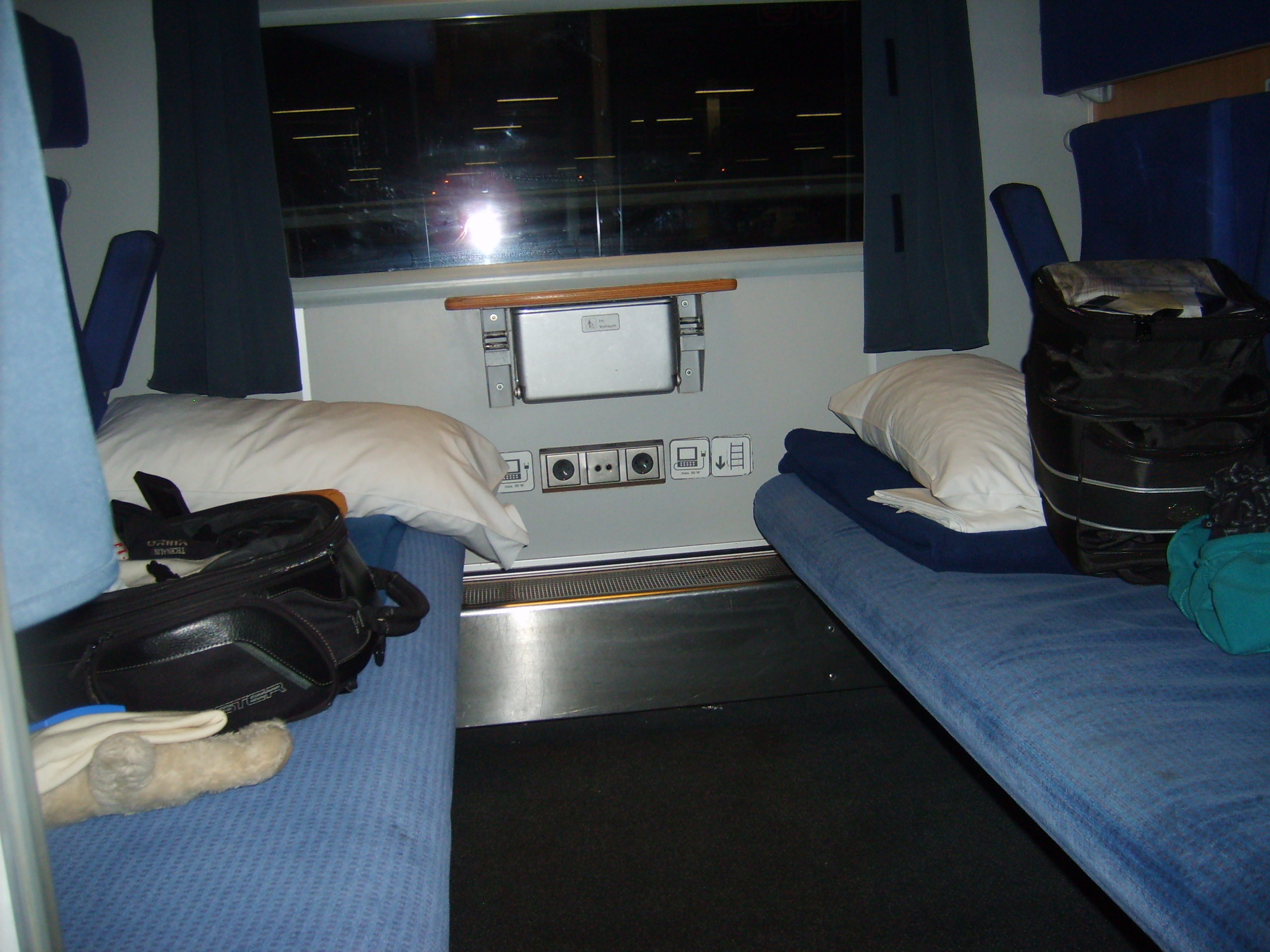
We booked a compartment for ourselves – adding about 15€ per head to the ticket price. As we managed to get a pretty smoking deal on the tickets, this was a logical upgrade. 187€ total, including two passengers, two bikes, and two breakfasts. By booking the entire compartment, we did not have to deal with anyone else. Many groups had the same idea – the three guys were two cabins over. The changing in the hallway thing worked for them, but not us. On the other side was a group of five riders, also bound for the Alps, but east instead of west. DB equips the compartments with standard european power outlets, plenty of lights, good curtains, and these things that function as beds. It all adds up to a decent way to get some sleep and distance in, at least for what was going to be a transit stage anyway. I collected some additional items at the Bahnhof grocery store, and we tucked in for the night. DSCN3941   IMG-20130920-00639

Getting off the carrier is no worse than getting on. If you’re 2.2m tall and riding a GSA, it’s clearly not fun, but for short people on short bikes, it’s not that bad. Just don’t lift your head up. You exit the carrier into a deployment lot where the riders assemble and build up their bikes for the big trip. Any luggage carried into the cabin is remounted, and then it’s off on tour! We are the last out, as I wait for my riding partner to get her bike built. DSCN3959

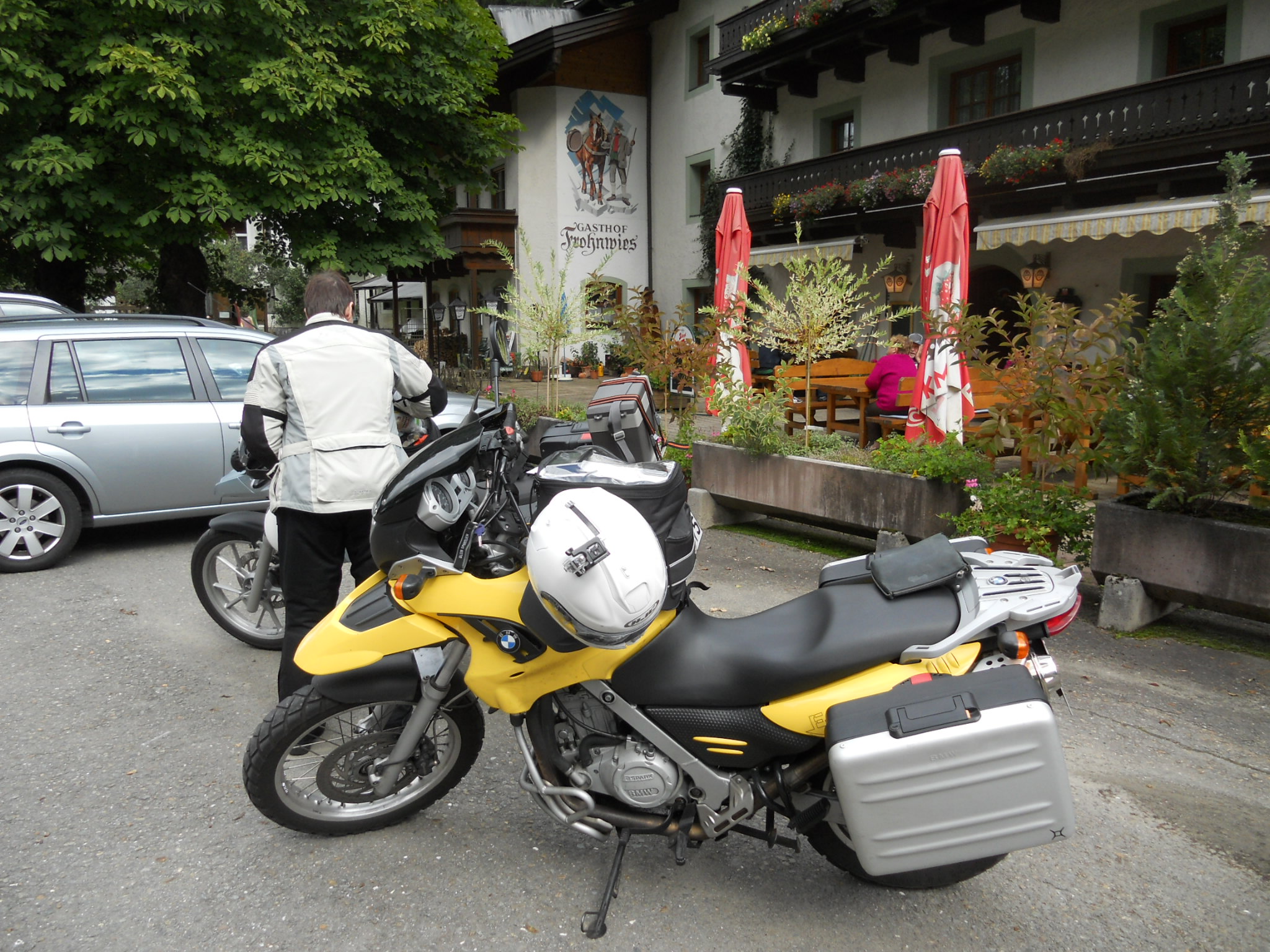
Day 1 is planned to take us first to the Sudelfeldstrasse and Tatzelwurm, then to Kitzbühel, Saalfelden, and down the Grossglockener Hochalpenstrasse to Linz, Austria. We start off on the A8, southbound to the B307 and the Tatzelwurmstrasse. The Tatezlwurm consists of a few linked up Kehren, or switchbacks, but not much else. The scenery is pretty, though. I’ll continue to use the words Kehren and tornante to describe these turns, depending on where I am at the time. From Kufstein, we head across the B173, B178, and B161 down to Kitzbühel over Pass Thurn, the first real pass we took. On the way, we stop for a bunch of decorated cows, the annual Almabtrieb in which the cows are driven down from the mountain peaks into the valleys for the winter. At this point, we run into the three guys from the train for the first time. At Pass Thurn, a tourist bus driver moves his bus for us so we could take a photo with the pass sign. From there, it is across the B168 and stopping for fuel (285.2kms on the odo, total 247,8 total), then up to Saalfelden for a quick shoppping stop and lunch at the Gasthof Frohnwies.

DSCN3960 DSCN3961 DSCN3972 DSCN3969 DSCN3977

DSCN3980

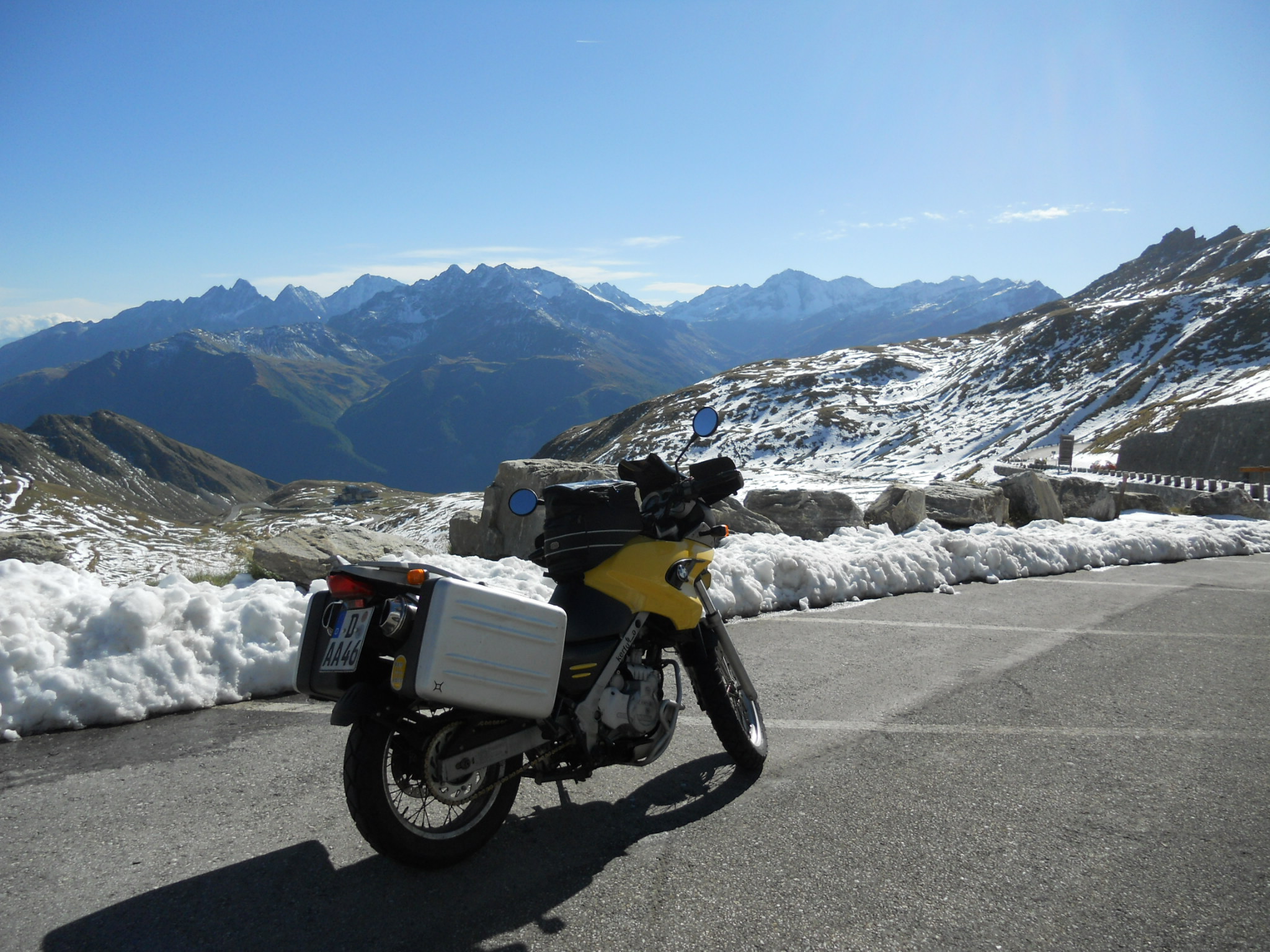
After lunch, we head on to the Grossglockener Hochalpenstrasse, one of the original Alps passes and the highest in Austria. It consists of beautiful ascent and descent ramps and two actual passes, the Fuscher Törl and the Hochtor. The Fuscher Törl is in the clouds when we ascend, on the other side, the Hochtor is in the sun. Not bad for our fist big ascents. We avoid the Edelweisespitze as it is not only in a dense cloud, but paved with cobblestones, a surface neither of us love. At the Fuscher Törl, we find cars being tested for braking function.

DSCN3983 DSCN3988 DSCN3991 DSCN3994 DSCN4001 DSCN4011 DSCN4014

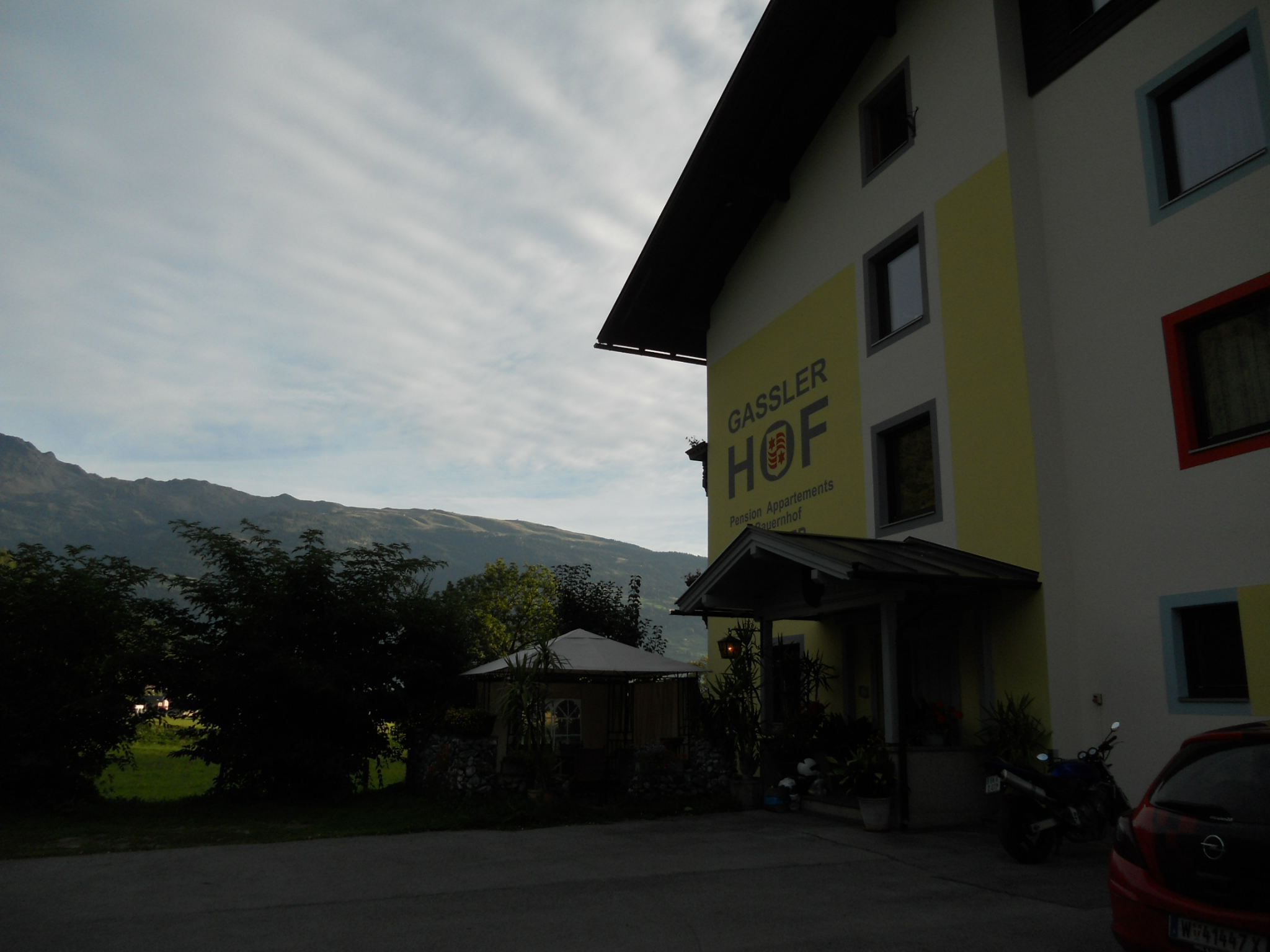
We wind down the day by heading to Linz, and just past there, find a small pension that offers us room and board for the grand sum of 35€ a head. Including a garage for the bikes, not so bad! On the way there, I have to make an ugly uturn and my bike takes a nap, but no damage and those Vario boxes are a lot tougher than they look. DSCN4021
I’ve planned an Alps tour with a GF.

Links to Google Maps tracks…

1 München Ostbahnhof to Lienz

2 Lienz to around the Sella Group

3 Sella Group to La Rösa

4 La Rösa to Landeck

4a Landeck/Perfuchs side loop

5 Landeck to Stanzach short way

6 Landeck to Stanzach long way

7 Stanzach to Stuttgart

The idea was to allow ourselves some short cuts and extra roads to use, depending on how the trip goes. We may also take an extra hour to ride into Lichtenstein, just to say we were there.

I’m one of the riders who wanted my feet down on my first bike. I am not ashamed of this. It was some security and I needed it. Being able to put both of my feet down gave me confidence that I wasn’t going to tip over, wasn’t going to damage my bike, and was going to make the ride. When I found my lowered F650GS, I was ecstatic. Honestly, it’s been the perfect starter for me. It’s got a propellor on the side, I can get my feet down, and it’s Mandarin Yellow. It’s autobahn-friendly, dirt-friendly, and (grrr!) garage-friendly. And, if I didn’t mention it, I can get my feet down. With a slight bend in my knees! I spent a year and a half with it becoming a confident and reasonably capable rider. To that end, it served its purpose with distinction.

My confidence grew as I got proficient with the baby GS and I was starting to wonder what it would be like to ride a non-lowered bike. I was starting to only use my toes at stops. I was bending my knees so that my heels weren’t down. I was experimenting with not having my feet down by tripoding all the time. Due to some motor issues this summer, I made the decision to buy a second bike. The prospect of a vintage BMW floated by, but I dropped it due to not wanting two dead bikes.  I wanted to try something sportier and smaller, but also, something that was a bit taller.
I went with a Honda CBR250R. Before I broke it in, I could sort of get my feet down, but not all the way. My heels had quite a sliver of air under them, depending on where I was on the seat. My feet came down in front of the pegs (gasp!!) when they came down at all.

Riding the CBR250R is a completely different experience from the GS, not the least of which is the fact that my legs are straight and my feet are mostly down when I am stopped. I tripod it everywhere, because both feet don’t go down on the ground like on the GS. And it is good. My increased confidence lends itself well to the higher seat and less foot contact. My improved balance makes handling the more top-heavy CBR much less of a challenge. And, frankly, having my down leg straight is really stable. Much more stable that I could have ever imagined when I started this whole riding thing. Now I understand those guys who look so cool and calm with a bike balancing against one leg, the other foot up on the peg. I can do that too now. 

Recently, though, I’d started to question my choice of the CBR, due mostly to the cost and the extent of the issues with the GS, partly due to the amount of back pain I’m enduring as I convert to the new riding position. I got the GS back on the road last night, and I now have a different perspective on the matter.

After riding the GS last night, I know that the CBR was not only the right decision, it was a good one and a very good one at that. Just as wonderfully good as the yellow GS has been. The CBR is teaching me confidence in a different way than the GS did. And honestly, the stupid GS pretty much rides itself. You tip it into a turn, it pops right back up. It’s so stable. The CBR wants to lean and lean and lean. Just going right to my dream bike, a 1983 R65, would not have given me a new view of riding like the CBR is giving me. I also wonder if starting low gave me a edge up on the going taller game – basically, I have something to compare taller to. I can from the get-go understand why the taller CBR is just fine and in some ways even more stable at a stop than my low GS. I can appreciate the CBR more because I know what it is not. Also, did I mention the GS is low. Like too low. What do I do with my legs low. I still love it, but now I think it needs a lift kit – I’ll find someone in the US to swap regular parts over for my short parts when I get home so I can put down a straight leg instead of a bent one and get some of that newfound stability.

I think that I can serve as the poster girl for starting with a lower bike and moving up. The low GS gave me the tool I needed at the time. It’s still a fantastic tool that I adore riding. But I didn’t stop there. I moved a bit higher, and I can now see an F800GS in my future. The seat height no longer scares me. I might not be seeing that if I was still fighting with a taller bike from day one. Just like your first bike doesn’t have to be your last one, it also doesn’t have to be te tallest one you ever ride. You can always move on up with the next one.

The answer to getting your feet down is do it if you need or want to, but stay open the idea that one day, you might find yourself pretty comfortable up in the air, sticking a toe out once in a while to touch down. It worked for me.

note – It was pointed out to me that the CBR is very light, and that is helping with the transtion. Yes. And there will be more transitions in the future, thanks to that.

I said ouch. That really doesn’t cover it. A PDPH headache is profoundly disabling and should not be taken lightly. I thought about it, and came up with this description: PDPH is like your head having back labor without the breaks in between contractions. Add in repeated hammer blows, and you are getting close. IE – if you’re a guy, you can’t even begin to imagine what this feels like. I suppose you could start with crushing your balls in a vice, but even that would just be starting to get  close to back labor.

On day four, I caved and called the ambulance. I’d woken up at 0230 in pain and was unable to find a position that reduced it. I’d tried drinking more water, taking an extra acetaminophen, and walking around. I ate a couple of gluten-free rolls. Nothing was helping, so I picked up the phone. The first ER sent me off to the big university hospital where my neurologist is based, and things got moving there. The ER doctor smiled a sad of kind smile and said “we can try some different drugs, but you just need to lay down”. I must have had the most incredible expression on my face. I remember telling her that I just wanted to sleep. Some medication appeared, and I fell asleep. Two hours later, I awoke and was whisked upstairs into a double room, where I promptly fell right back asleep. For several hours. Make that days. I slept through day five and most of day six. As I did this on one side, without moving very much, I managed to pinch a nerve on the left side of my skull, which took some time to unkink and left me with a stuffed up eustachian tube for a while.

On the afternoon of day seven, I sat fully upright for the first time in a week. A few flights of stairs brought back the tinnitis, but it abated after a while. The Chief of Neurology visited and said “you sign the form, but it really doesn’t prepare you, does it?” No, it does not. She was quite kind, something often missing in doctors, and went through my symptoms and how the situation progressed. She noted that when she saw my chart, the first thing she thought was “skinny chick, she’s toast”. And there I was, toast. She also confirmed one of my suspicions – that the most damning factor is low blood pressure. As I’d woken up one morning and produced a spectactularly fabulous 80/60, you can see where I was coming from.

Day eight was finally the day that I could say I was human again. After a week of either significant or total disability, I was so thrilled to simply stand up tall that I wanted to walk around for hours. Had the sun been out, I think I would have fainted from joy. I was discharged and went shopping, just to look at things that weren’t on the floor.

The moral of this short series is that, in the words of Mark Twain (who is actually not the author of the quote), there are lies, damn lies, and statistics. And in this case, the statistics told the truth, but not the truth that applied to me.

I mentioned the 20% thing, and my response. While I was holed up under my desk, I took some time to read up on current medical literature to figure out how that 20% was derived. By the way, morbidity is a fancy word for occurence. No one died.

Once you get the headache, the dura needs to heal so the CSF will stop leaking and the headache will stop. Roughly 24% of PDPHs clear up in 1-2 days, another 29% in 3-4 days, and another 19% in 5-7 days. By two weeks, a total of 80% of PDPHs have resolved themselves.

In any population, there are people who have issues and people who don’t. Over the whole population, you can get a general risk factor. But.. certain parts of the population are probably going to be more at risk that others. In my case, I hit the jackpot.

There are three significant studies of the morbidity of PDPH in dural puncture patients. The earliest and most quoted is from the late 1950s, and already a disturbing trend was evolving: there’s something about Mary, and it’s not her hairdo. After controlling for the possibility that women are simply over-reported (due to punctures during attempted epidurals on the delivery table), it was becoming clear even back then that being female is a clear risk for PDPH. Being female raises the risk to close to 40%, effectively doubling it. The two later studies looked at other physical factors, such as weight, physical health, physical fitness, and age. Again, the studies were controlled for the potential over-reporting of females of childbearing age, but an even scarier, and more complete, picture emerged: physically active females with lower body mass indices and age from 18 to 40 years old were shown to have a morbidity rate of 70%. Interestingly, being obese and having high blood pressure cuts the risk to nearly zero. There you have it, donuts are your friend.

It turns out that those of us who love our yoga, our running, our daily attack on fat molecules, also maintain very healthy and flexible tendon and ligament tissue. The dura is just one big ligamentous envelope. One big slow-to-heal ligamentous envelope. Healthy ligaments are stretchy and under some tension, so the small tear that the needle makes pulls open. Less healthy ligaments don’t stretch, they just kind of sag there, so the sides of the tear do not pull apart at all. The pulled-apart opening takes longer to heal, because the little ligament fibres have to reach the other side to join up and patch themselves together. Curse the situps and the sun salutations!

Ouch. That would be me, right there, physically fit skinny chick. Had I known about the 70%, I still would have gone through with the puncture, but I think I would have been less surprised  by the onset of what turned out to be the most miserable week of my life so far. I would have been more prepared for the disruption. I might have even taken the pain more seriously when it started and just laid down. But I didn’t, and I didn’t. Ouch.

The release form is rather vague. The doctor is often vague. “About 20% of the people get the headache.” Ok, so, for a healthy, physically active female, this should be nothing. No risk. Um, yeah.

At a time ranging between 12 and 48 hours after the dural puncture (the dura is the membrane that covers the brain and spinal cord), a certain group of people experience a pressure drop in the cranial cavity due to leaking cerebral-spinal fluid (CSF). This pressure drop can be very small or very large, but in all cases, it is very painful. Not that the brain feels pain (it doesn’t), but the tissues surrounding it, and even the skull itself do. Nerved and blood vessels get crunched under the weight of the brain, which is no longer floating in a nice CSF bath. In fact, if care is not taken, you can get a nice concussion going. Yuck.

For me, the onset of the PDPH was about 22 hours after the puncture. I was driving to work when I noticed that my neck was becoming increasingly stiff and painful. That was my brain, snugging up to the rear cranial shelf, crimping some veins while it was at it. A quick check of the internet when I got to work revealed that yup, I had a PDPH. Ok…..

When I signed the form, my doctor was careful to tell me that there was no real cure for a PDPH except time. Pain pills don’t work. The only thing that works is lying down, to equalize pressure throughout the spinal and cranial cavities. You can take a bit of the edge off with caffiene and its wonderful vasoconstricting properties, but you cannot stand or sit up.

I spent the day with my laptop on the floor and my head between my knees. I kept this up for another two days, managing by keeping my head down, taking a small amount of acetaminophen, and a large amount of tea. Most interestingly, I could drink coffee. Normally, coffee makes me sick. Too much caffiene is too much stimulation for my poor little self. But in the throes of this mess, it was nothing. Not a single cell was jittered.

Wow.

For those who don’t get the joke (seemingly everyone I know), the title refers to a line in the movie Spinal Tap, in which lead guitarist Nigel Tufnel informs journalist Marti DiBergi that his Marshall amplifier head is “one louder” because the volume knob is numbered from one to eleven, instead of one to ten like a regular production model.

There you have it. I have now had a spinal tap. Also known as a lumbar or dural puncture, it’s a test used to identify issues involving cerebral-spinal fluid, the stuff that keeps your brain afloat in your head and prevents concussions from occuring when you move your head around. The actual spinal tap procedure is not particularly painful. If you’re me, it doesn’t really hurt at all. Removing the needle is more painful than inserting it. Et cetera. If you don’t mind, I’ll keep the reasons for the test private. The results were  completely negative, which should suffice.

All of this is not sounding especially exciting, is it? Certainly not enough for a blog post from this somewhat reluctant blogger. You are correct, so far, the whole spinal tap thing is, frankly, another boring medical procedure that people occasionally have to undergo. You go to the doctor’s office, sign some forms, and get poked in the back. Typically using 22g Quincke needle, between L4 and L5. About 5ml of fluid is removed, you lay down and rest for a little bit and then you go your merry way.

My neurologist, a rather studied dude who carefully answered my questions about the procedure, was rather business-like throughout the whole affair. The actual puncture is a very routine procedure, one done by neurologists  on a very regular basis. It is the full Monty, while the more common epidural insertion is the specialty of anesthesiologists. In an epidural, care is taken to avoid a dural puncture, because firstly, it’s not necessary, and secondly, well, it can cause issues.

The issue in question here is called the Post-Dural-Puncture Headache. It’s why you have to sign that release form before the test.