Archives

All posts by atomicalex

The 1% moniker has taken on some new meaning of late. Formerly the exclusive province of outlaw motorcycle gangs, it now includes the richest of the rich. I’m not going to talk about either of those groups. I am going to talk about something far more exotic: high school kids who drive stick shift.

I taught my older son how to drive on my old B5 wagon. The hydraulic clutch and super short solid linkage make it so easy to drive, it’s like eating cake. It spoils you, but you love it. A friend of his was learning to drive at the same time and that kid’s parents had coughed up a Dodge Dart with a manual trans. Exactly two other kids in his class of 300 had any experience with the old ballet á pied, and neither of them had routine access to a shifty car. Going out to lunch was fun because it nearly always involved the Dart and it also nearly always involved the kids who could drive it. The four of them morphed into a sort of teenage boy stick shift clique. Who knew?

One weekend when I had the wagon in the air, my son asked me why more kids weren’t interested in cool cars.

I had to think about it, because being interested in cool cars was is such a natural state for me that the idea of not being into them is completely foreign.

We worked out the population of the school parking lot.

40% of the kids had the latest and greatest safest car

8% of the kids had the most expensive car (it’s a pretty well-off place)

Another 40% had a recent hand-me-down

11% had a cheapo CL special

1% had cars that could maybe be described as interesting. Ok, it was one car. An old Bronco that a kid was working on. And a Ruckus.

We talked about his friends and what they wanted. Most did not want a car at all, but needed one to go to their jobs and back and forth to school. Some wanted nicer cars, some wanted faster cars. Only a precious few kids were actually interested in cars because cars.

I suggested that he survey kids and school and ask them what car they would have if nothing stood in their way. He said most kids just stared at him. He got some good answers, heavy on the AMGs and Teslas, but still more than just “something nicer”. More than a few wanted a car with a better stereo or better conectivity. A small handful, less than ten, wanted an older car for one reason or another. He asked why they didn’t have one, or weren’t trying to get one.

My son loves Initial D and all of the 80s goodness it features. Midway through his senior year, he discovered the cars&trucks section of Craigslist and began the hunt for an early Toyota MR2. I admit that my heart fell, I’m a Honda and VW girl. But the AW11 has pop-up headlamps, and I always allow pop-ups. Especially 6054s.

I set some rules out. It had to be running. It had to be reasonably straight. It had to have a clean title. It also had to be watertight. We looked at a lot of MR2s.

So why weren’t more kids rocking classic iron? We uncovered a set of conditions that had to be met for kids to have cool cars, and they turned out to be a high hurdle in these times. The first one is money. Fun cars tend to soak it up. Even cheap fun cars, ask any LeMons racer. Many kids cited not having the money to buy their own car as a key hurdle. The second is space. You have to put it somewhere. If your parents already got you the latest in hybrid technology, that is already taking up your allotted room. Quite a few kids were concerned about having that room, particularly garage space. That brings up part three: parental acceptance. You need parents who can feel the love. Without that, you are fighting an uphill battle against everyone, even those who should have your back no matter what. Nearly every kid said that their parents would support a hobby that they (the parents) were into, but didn’t see value in old/interesting cars. A major thread was safety. Kids keyed in on the fact that older vehicles are simply not as safe as modern ones and this was a huge barrier for their parents to overcome. The last part is tools and knowledge. If you have car-people parents, this one usually isn’t an issue. If you don’t, then you are looking at investing even more of your precious money in the hobby, money you already don’t have because you spent it on that AE86 or urQ that fills up every corner of your brain. The knowledge part is no small hurdle either, learning cars from scratch without a mentor is not something I would really wish on anyone. Here, take this complicated machine that is trying to set itself on fire and is made of about four thousand parts and sort it. Before your dad gets home so he can have the garage back. Kids felt this was the least significant barrier and felt that they could learn. As long as their parents were open to the idea to begin with.

It’s just not that easy to enable the car thing in kids, and the barriers to entry get higher every day. The kids who do pick it up are unique, their own version of 1%ers. Like the OMGs, they have to find a sponsor, commit, and do the deeds required to get in.

My son has a rusty MR2 now. I’m grudgingly learning how to read the big green book, and quite grateful that Toyota uses a slightly modified version of Bosch notation for their wiring diagrams. I’ve learned that MR stands for midship runabout. I’m reminding him that this is just his first one, so he needs to get all of the practicing out of the way so he’s ready for the perfectly clean one he dreams about. MY SON IS LEARNING RWD.

The college version of the high school stick shift club is the autocross club, and there are apparently quite a few kids in it. More than the high school survey would predict. It’s nice to know that there are more of these kids out there. I think I want to meet their parents. We can trade notes.

I love camping, particularly fall camping. Temps are cooler, leaves are beautiful, and the air is usually pretty dry. It’s possibly the perfect camping season. However, my last few fall trips have left me a bit cold, largely because I chose poorly when packing my bag – my sleeping bag, that is.

Like most campers, I have an assortment (ok, way too many) of sleeping bags that I have accumulated along the way. Two Boy Scout sons hasn’t helped. I have everything from an ultralight +50F Lafuma to a -10F no-name bag from CampMor. Don’t ask about my tent collection! My bag collection is heavy on the standard +30F bags, which I’ve always found to be a poor tradeoff between the temperature range they are effective for and the space they take up. With my last few trips in mind, I took some time to try to sort out what I was doing wrong bag-wise.

Lots of camping (car, bike, and backpacking) has taught me that those utilitarian +30F bags seem to just never be warm enough to justify the space they take up, so I often end up bringing my tiny +50F bag and a blanket on moto trips when I really should be going for a properly warmer bag. Being female doesn’t help in that department – for years I’ve wondered who exactly can deal with 30F in a +30F bag, and recently I learned that it is guys, who are naturally warmer than ladies. No wonder I’ve never been happy with my +30F bags – it turns out that they are really +40F for me. So the ol’ +50F bag and a blanket aren’t any different in function, and are probably actually warmer. It’s time to break down what I actually need in a bag.

Packing for a motorcycle camping trip is an exercise in not just weight saving, but space saving. Every gram counts and every litre, too. I’m clearly biased toward space-saving, based my past behaviour, so that is going to take priority. Thankfully, most websites selling sleeping bags include information about both packed weight and size.

Making the decision to go small requires you to accept the limitations of materials. Modern synthetics are pretty awesome, but they are also puffy. A +30F synthetic bag will be roughly 1.5 times the size of a similar downbag, even in a compression sack. It will also weigh more. The tradeoff for this extra space and weight is better warmth when wet. Down is admittedly useless when it gets wet. However, it is very lightweight and can be compression packed to tiny proportions for travel. If you know ahead of time that you are likely to get wet, down is not a good choice. But if the humidity is low and flooded tents not likely, down will save you space and weight like nothing else. It’s also very very warm.

My first down bag was a +30F affair that I sold because I rarely used it. I loved the warmth, but lived in fear of the dampness that would kill it. Today’s down is a different story as it is treated to resist moisture and stay fluffy. It won’t change the flood response, but will resist humidity and condensation that would have done in an older, untreated bag. Some newer bags incorporate durable water resistant coatings to reduce the infiltration of water, too. Down has come a long way, baby.

Synthetics have, also. Newer synthetic bags incorporate linings that improve the temperature rating by carrying part of the thermal load. A fleece lining can add ten degrees to a bag’s rating. Fills have gone beyond the traditional Hollofil fibres to incorporating Polartech-based materials that can bear a ton of water without compromising insulation. Some newer PolarGuard bags will dry simply from your body heat. When you have room, these are an excellent choice.

I’m me, though, and after my last few cold excursions, I decided (sufficiently in advance of my next trip) to go bag shopping, and to open up my mind to down.

Research on various websites led me to the Marmot Angel Fire +25F 650 fill women’s down bag. Marmot rates their bags differently for men and for women, with women generally rated at about ten degrees Fahrenheit warmer for comfort. The +25F Marmot bag is actually a +21F for women and rated at +9F for men. That is a big range, and it fully explains why my +30F bags have never been enough – they are effectively +40F bags, and in the fall, that’s a very real number. Facing the limit of your comfort range at night is not fun, I can tell you!

I took the Angel Fire bag camping recently and found it to be pretty great. It measured up lighter and smaller by about 10% than my favored +30F bag, which made it easier to pack on my bike. It was definitely warmer – I did not wake up cold at any point during my night of lows in the mid 40s, and also did not wear any extra clothes to bed. That is a new one for me, as a +30F bag has always meant a least a fleece jacket and leggings in the sack. This bag kept me warm in a tshirt and shorts. That meant for a cold change of clothes in the morning, but nothing that was too difficult. Like most newer womens’ bags, the Angel Fire is cut wide at the hips, making for a very spacious sleeping comparment. I was able to move very freely inside of the bag and even get my knees up quite a bit without folding up the bag. My one warmer night in the 50s found me opening up the zipper and airing out a bit. Again, a welcome change. Two nights of rain did not dampen the down or my experience with the bag – it did not contact water directly, thank goodness, and any condensation from my tent did not have a negative impact.

I am pretty excited about future trips with this new bag. Now that I’m reacquainted with the wonders of down, I will be less stressed about bag selection in advance of trips. I still feel there is a place for synthetic bags – my adored +50F bag is proof of that – but for anything colder, I am going to be living it up in my new small warm down bag.

Every year I add to my motorcycling story. I learn something new, or I reinforce something that I knew, but didn’t use enough or forgot or just never really understood. This year, it’s that thing with the knee. A catch, though – I don’t mean my inside knee.

Some years ago, I was rounding a hairpin in the Alps and was headed for a wall. I managed to jerk my head around at the last minute, put some weight on the outer peg, and force myself to relax and let the bike do its thing. Of course, the moment I did those things, the bike magically came around and I went on through the curve like I was supposed to. There was one peculiar sensation that I felt that had me thinking – as I relaxed on the bike, I felt it holding me up. As I came out of the turn, I felt the bike stand up under me, pressing into my outside knee. My first thought was that this must be what hanging off feels like! Not that I was off the seat or anywhere near hauled over, but that the bike was doing the work for me. I was just piloting.

I made a lot of assumptions there, but the thing with the outside knee has been a point of interest for me since then. This year, I tossed up my riding calendar quite a bit and put a long, twisty trip at the start of my season instead of waiting until the end. Instead of spending my summer commuting on Michigan’s boring, straight A-to-B roads, I pushed myself into the fun stuff right away. The (wonderful) result is that I remembered that thing with the knee and have been (and will be) playing with it for my whole warm season this year, instead of only remembering it at the end. 

Technique is important to every rider, on the GP course or a sandy trail or anywhere in between. Clearly, it is not sufficient to relax and drape oneself over the bike and pray. This is effective, but kind of scary. One must control not so much the bike, but one’s body position relative to it. I learned early on about gripping the tank with my knees instead of deathgripping the bars. That is nice, but what about when you don’t want to go straight or sit in the same position all the time? How do you grip the tank with only one knee? There is way. It requires good boots and a little sense of geometry.

Gripping the tank is important because it stabilizes your lower body on the bike and allows your upper body to relax and freely move while still maintaining some form of referential position to the steering head and bars. It extends the frame of the bike up through your hips. Simple geometry reminds us that there is now a triangle of femur, femur, and tank. Triangles are very stable constructions! Additional fixture points are your feet on the pegs (more triangles!), as any dirt rider who prefers to stand on the bike will tell you. One your body is fixed to the frame, you can move around quite a bit up top and still be sure that you will not have any wierd steering inputs. 

Fixturing to the bike frame with one knee is not so obvious, unless you are the aforementioned dirt rider. I start by insuring a solid grip on the outside footpeg. This is where decent boots come into play – if you cannot gain purchase on the footpeg or your boot slides under force, you will struggle with this. Both hooking (your arch on the peg) and balling (up on the ball of the foot) are just fine for this, although balling allows you a bit of finesse that hooking doesn’t. It’s your outside foot and you won’t grind it off. The goal is to have a solid contact point with the structure of the motorcycle. Once the foot is in place, press your knee (of the same leg, natch) into the tank. Hard. This forms a triangle of lower leg, footpeg, and frame (ok, motor/frame/tank, it’s a solid thing, ok?). You are fixtured to the outside of the of the motorbike. From this point on, it’s what you do with your top and inside halves that makes the riding magic. The fixturing is the base you build on.

The fixing to the bike in this case has the same goal as gripping the tank – fixing your lower half to the bike in a manner that allows free motion of the body parts that will impact steering geometry (shoulders, arms, etc) in the desired way. Once the outside knee is solidly mated to the tank, even the outside femur is free to move (!). This, of course, leads to that other thing with the knee, the grinding off of knee pucks, when motion of the outside femur results in sideways displacement of the hips from the motorbike’s seat. 

This one-sided fixturing technique is hardly rocket science, but it can lead to more confident riding in all conditions. It forces the rider to put pressure on the outside peg – a key component of pro cornering. It encourages the rider to move around on top of the bike, improving balance skills. And it gives the rider a more profound sensation of what the bike is capable of by transmitting more of the bike’s willingness to both drop in and stand up to stand up to the rider’s body. Instead of moving the hips – a somewhat disconcerting feeling to many newer riders – this moves the knee and imparts the feeling that the bike is supporting the rider, not the other way around.

I’m enjoying it, even in Michigan, on our profoundly boring roads. What few turns we have are more interesting and more engaging. I might even get around to hanging off one day, who knows. You know, do that other thing with the other knee.

Quit boiling your broccoli. Quit microwave steaming it. Try braising it. 

Seriously. 

Cut up a head of broccoli (or two). Rinse it well. Put a frying pan on the stove and heat it. Add one tablespoon of butter and melt it. Toss in the broccoli florets. Add about an ounce of water. Turn the heat to high and put a lid on it. Best is a lid that fits down in the pan and sits on the broccoli. One of those silicone thingies is great.

Cook for a few minutes, until the color changes, then remove the lid. Continue cooking until the water is gone. At this point, your broccoli is ready to eat, unless you want to give it a little fry and brown it. 

This is actually really similar to steaming, but with higher heat and butter. 

If you are really adventurous, don’t add any water. The broccoli will cook just fine and the florets will brown in the most amazing way.

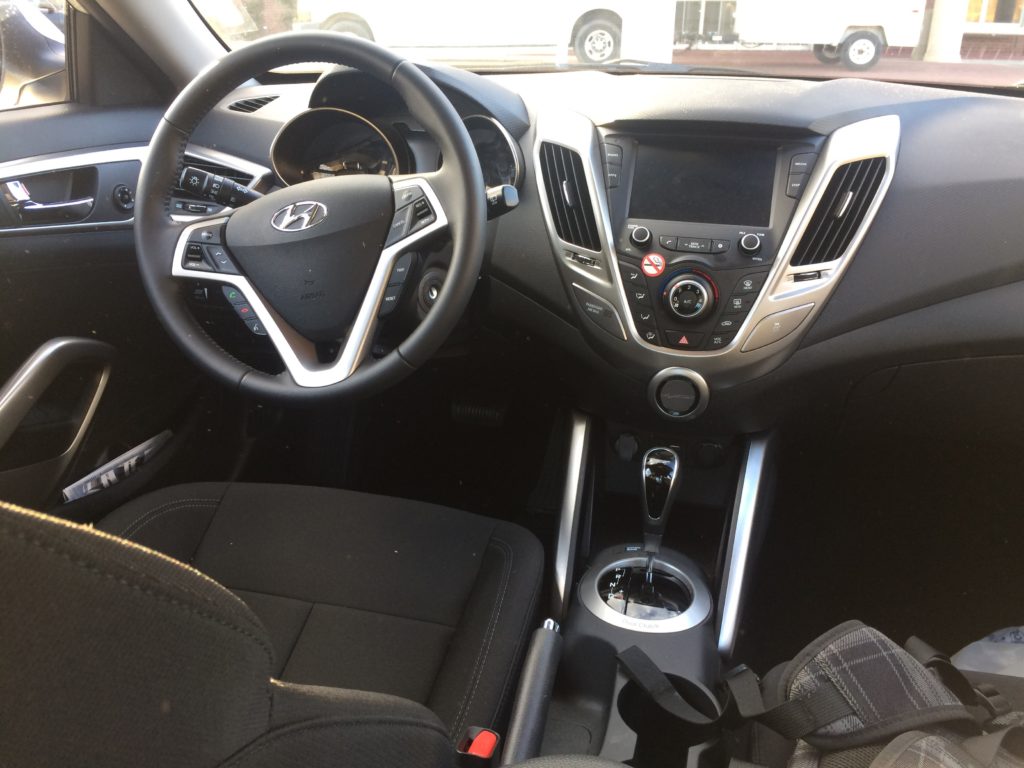
I’ve been trying to get a Veloster as a rental for a while, and Enterprise delivered for me in Altanta this time around. Between the optimistic name and the cool looks, I was looking forward to see what Hyundai brought to the table in the sporty 2+2 segment. Sadly, rental spec is not kind to this silly little coupé. That’s too bad, because the Veloster has some fun elements amid a laundry list of mediocrity usually reserved for lower-budget American cars.

The overriding feeling one gets from the Veloster is “damn, it would be cool if…..” I think the one feature that truly sums up the car is the Veloster logo screened onto the front seat backs: most cars would have embroidery where the little Hyundai has some sort of puffy ink. The entire interior is best described as a hot mess. The front seats are shapely and body-hugging, with solid bolstering, but the lower center cushions are flat and cardboard-y. After a mere half hour, my butt was screaming. And what are great bolsters without adjustable lumbar? Not much. Adjustability was fantastic in all other dimensions, though.

Moving on to the IP, holy underware, Batman. The dash looks like a 2010 Civic got it on with an old Grand Am. It’s actually better in daylight than at night, where the endless array of backlit buttons is also endlessly distracting. The MMI screen is raked back at such an angle that only the lower half is easily reachable. Thankfully Apple CarPlay seemed to work fine. The silver-painted plastic trim is *everywhere*, spilling onto the doors in the form of upper trims and very intrusive grab handles that duplicate the function of the traditional cup pulls set further back and obscure access to the window and lock controls. The controls for the HVAC are decently laid out and took little time to sort. All functions worked, too. The MMI and rear camera setup functioned well and with minimal fussing. I was able to connect my phone via cable and Bluetooth.

The outside of the poor Veloster is part of the problem. It’s overstyled to an artful degree that so overpromises that the car could never really deliver anyway. The rear treatment is, in, my opinion, pretty good. Where the Chrysler Cross(back)fire looked unfinished, the Veloster comes to its conclusion directly and forcefully. The car sits balanced front to back with well-defined haunches and brings to mind some of Renault’s artistry in the Wind. The front end suffers a bit from excessive Canard syndrome, but the whole look is consistent and grew on me over the course of my rental.

Where the outside and inside meet, visibility goes out the proverbial window. Aside from the interesting glass hatch (I like it), there is not much greenhouse in the Veloster, making visibility an afterthough. Particularly bad is the view over the left shoulder, which is simply a wall of black B pillar. The driver’s mirror includes a blindspot viewer in the upper outer corner to help. The right side of the car benefits from the third door, which includes a window that can be opened to relieve wind noise and booming from open front windows.

Rental spec sadly meant that the Veloster I was driving was equipped with the normally-aspirated 1.4l mill and a functional DCT automatic. Oh, man. There is absolutely nothing redeeming about this combination. I spent about 80% of my time in the car thinking “damn, this would be pretty fun with a snail and a stick.” The promise spoken by the Veloster name and the hyper-styled exterior fell dead and cold on the stone-deaf ears of the powertrain. It didn’t even sound good.

General driving dynamics were decent. Road grip was good and for as much as you could push the tiny mill, the suspension was not the weak point of the system. Handling was another area where the car would benefit from an upgrade, but I’m not going to say it needs one, because the available power will never get you in trouble that way.

I realize that it sounds like I think the Veloster is a bad car, and that is not true. This is not a penalty box car (even in rental trim), nor is it a modern Mustang II. It’s actually a fun little way to get around that could do with some upgrades and factory performance options to help it live up to its enticing name. To start with, a high output motor and a decent six-speed manual, along with improved seats. Everything else works fine and is not only functional, it’s largely easy to figure out and use. The rest of it is all style points, and truthfully, if you’re a hot mess of a person, the Veloster will be a great fit for you right out of its hot mess box. You’re trying just as hard as Hyundai is.

I’m coming to LA! I said.

Let’s ride bikes! my friend Ronald said.

Bikes! my friend Andria said.

Race bikes in a wine cask! this guy Peter said.

Occasionally you get a work trip that goes somewhere really nice, like southern California. I have quite a few friends there, and like to take the opportunity to spend time together whenever possible. Friend Ronald and I make the effort to ride motorcycles together when we can, and my recent trip to Long Beach and Compton was no exception. We were privileged with loaners from Kawasaki and the Motorcycle Industry Council – I spent my day putting the new  Ninja 300 through its paces and Ronald bounced around on a nicely kitted Versys. We ended up riding with a bunch of friends, new and old.

My trip started on arrival at SNA where I picked up a Ford Fiesta with the laziest torque converter in the world. Oh, you want to accelerate? Let me think about that. Absolutely killed the fun part of the car, even in sport mode. My gf Suzie had warned me about taking the 15 (the north route) and suggested the south route instead. I peeked at the map  ahead of time – the south route was CA74, the Ortega Highway. While hardly an Alpine run, it’s a tight, twisty run over a 2665′ pass that takes you from the coast to the valley and on toward the desert. Roughly 20 miles of fun, even in the recalcitrant Fiesta.

I arrived in Wildomar and was met not just by Suzie, but friends Teri and Richard! A great surprise for me. We dined at a Mediterranean restaurant and shortly after, I flopped over, sound asleep in a nice, comfy bed. I needed to be out of the house at 0530 in the morning to head back over the Ortega to meet my riding group.

I was joined by friends Ronald and Andria at the Motorcycle Industry Council, home also to the Motorcycle Safety Foundation. Andria had arranged for the loan of two Kawasaki motos for Ronald and I – the delightful Ninja 300 for me, and a Versys 650 for him. Thankfully the Versys had big panniers, because we couldn’t get the seat off the Ninjette so I could mount my tank bag, and Andria’s beautiful Indian Scout had no storage, either. We teased Ronald a bit about carrying two women’s purses. From the MIC, we headed off to Schubert North America to pick up Peter Meade and his big GS. Peter had arranged a day loan of Schubert’s C3Pro Women for me to test out. I’m desperately in need of a new helmet, so…… He also had arranged for us to visit MotoDoffo at the Doffo family vineyard near Temecula.

We headed out the way I’d come in – over the Ortega. Every road looks different on a bike. No matter that I’d come over it in a car, all I’d learned was the basic layout. On the bike, the twisties took on new looks and lines. The little Ninja was flick-flick the whole time, limited more by its rider than its mechanicals. We stopped at the top of the road at the Overlook, a classic bikertreffpunkt like I used to go to in Germany. Tons of gorgeous sportbikes everywhere, and a great view of Lake Elsinore.

img_5357.jpg

We headed down into the valley to Temecula for a late breakfast at the Swing Inn. It was filling and yummy. We discussed the next phase of the ride – we would visit MotoDoffo, a collection of older racing bikes displayed at the Doffo family vineyard. We would also meet Suzie, Teri, and Richard. It turned out that Suzie knew the Doffo family through her experience in racing and wine, and if Marcelo wasn’t home, she’d rope son Damian into taking us around. We rode out of Temecula into the sun and wine country.

img_5370.jpg

Arriving at Doffo, we parked and began wandering around while Peter hunted down the family. Suzie&Co arrived and introductions were made. From there, it was BIKES!

The Doffo family have been racing motorcycles and participating in the racing community for multiple generations. Once the winery was up and running, they decided to install a homage to 1970s motorcycles and mototechnology in the form of a museum. Featuring everything from your basic SuperCub to a big cube KZ, it’s a love letter to two wheels with autographed pictures from Ducati. My favorite bit was a light-up sitting Bibendum figure, as I have now seen two of them and am convinced that they are real. I love Bib and all things Bib.

img_5391.jpg

img_5392.jpg

Damian Doffo guided us around the display and pointed out some of the more significant bikes, including a particularly rare early Ducati owned by his father. I gawked at the parts in a display case. We learned about the Doffo family’s experiences racing both bikes and cars, and I chatted up Damian about our shared experience in the 24hrs of LeMons. Imagine that, two LeMons racers in a room full of bikes. We tried valiantly to explain it all to the others, but I guess you only get the LeMons if you get it.

img_5355.jpg

We visited the back shop, where the restorations take place in between pressings. More Ducati, including a Ducati rototiller (!), which is right up there with MI friend Ben’s Lamborghini orchard tractors. A lap around the dirt loop outside of the ship (in a golf cart) had us holding on for dear life.

img_5393.jpg

Richard led us back to the Ortega on a beautiful back road around the “back” side of town, climbing up and over a mountain range that reminded me more of the Angeles Crest than the Ortega. It was over too quickly – we found ourselves back at the Lookout at the end of the day. From there, we decamped to the MIC office to hand over the keys and retrieve our purses, and wound ourselves down from the joy of a great day of riding.

My day ended with a nice, quiet tapas dinner with Ronald in Long Beach. It was a perfect start to my week of training in California, something I apparently need to do a lot more of!