Archives

All posts by atomicalex

I was back in Germany again for the last two weeks.

The Jeep Renegade is a huge hit over there. Not only did I see a bunch of them, but all in nutty loud colors and parked to be seen. I like this vehicle a lot and I think FCA hit a home run with it. The popularity in Germany is proof.

Motorcycle parts are far more widely available, as usual. I managed to warp a rear rotor (yes, I actually warped it) due to the crappy Brembo 11mm master cylinder corroding again. In the US, the best fit rotor is the stock BMW one, for $248. EBC makes one that I haven’t seen yet for about $150. The OEM TRW rotor is a whopping 68€ from Louis. Yes, I brought home a brake rotor. The CBP guy who stamped my passport back in looked at his deskmate and said “I clearly need to go over there and buy some parts.” Yes, you do, Mr CBP Officer. A set of matching TRW pads cost a whole 37€. With the exchange rate at stupid lows, that was a no-brainer. I haven’t really addressed the spares situation in the past, but thanks again to Motorrad Alexander who delivered an annoying piece of wiring harness to my desk for 20% of the cost new. It’s in great condition and should resolve some nagging issues I have with harness damage on the BMW. I’ll be repairing the old one and saving it for the other frame.

Eggs. When you go to the breakfast buffet in Germany, the scrambled eggs are real eggs. I forgot how awesome this is until we went to San Antonio for a long weekend a few weeks ago and had the American version made from powdered eggs. Not even close.

I always forget how much I miss riding the trams and walking everywhere. It’s sooooo nice. A totally different kind of mobility.

I do have a gripe with airline food. I have Celiac disease, which can suck for a variety of reasons. One of them is airplane food. I finally figured out what is going on with the grilled chicken breast, broccoli, and rice that I get on every. single. flight. It’s not only gluten-free, it’s Kosher, Halal, lactose-free, low sodium, and whatever else you can come up with short of vegetarian/vegan. It’s also generally flavor-free and boring. Everyone else gets something different each flight, I get that damn grilled chicken. I have to beg for butter, explaining that I am not lactose intolerant or anything else. I do love the rolls that I get on the flight home, they are way the hell better than the rice cakes I get on the flight out. One positive note is that Delta flight attendants, pursers, and stewards are generally quite food allergy aware. This time, I was able to get scam an ice cream and it arrived with no cookie! I know that the airlines are kind of dependent on LSG or whoever their food service contractor is, so I don’t want to come off as bagging on Delta. But I would like some fancy food once in a while!

I was counting cars in the parking lot for a project and discovered that Germans like big window glass just as much as Americans do. I wonder if the area of the greenhouse is why people here like SUVs so much? With sedans losing glass at every increasing rates, it seems that eventually the only way to get a real rear window will be in a minivan or other xUV. Hmmm. Now I want to call hatchbacks UUVs – urban utility vehicles. I guess minivans would then be FUVs – family utility vehicles. Let’s tacticool name all the vehicles!

I was completely shopped out from my last trip, but not enough so to avoid looking in the windows at Hein Gericke. Oh, damn, another pair of gloves – from Richa and size Ladies’ XL. What a concept – I have a difficult time finding gloves with long enough fingers, hopefully these will do it. Thankfully, LS2 seems to be doing a great job of bringing HG back into form. The new assortment is quite attractive and continues the tradition of high-end product lines.

I (finally) learned how to pronounce Garching. I used to say /gar’ shing/. Now I say /gar’ hing/. With that silly-sounding Bavarian hissing H.
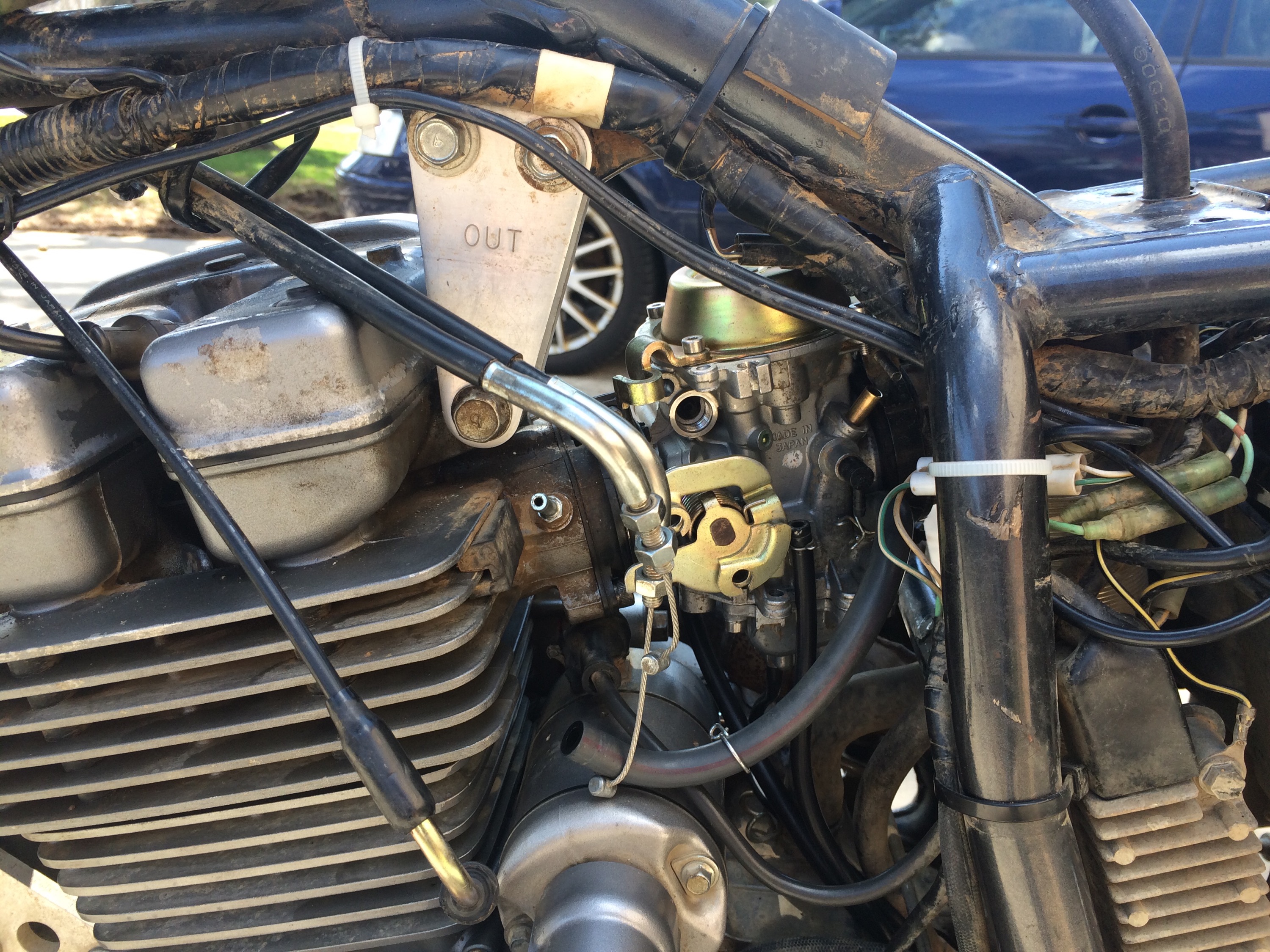
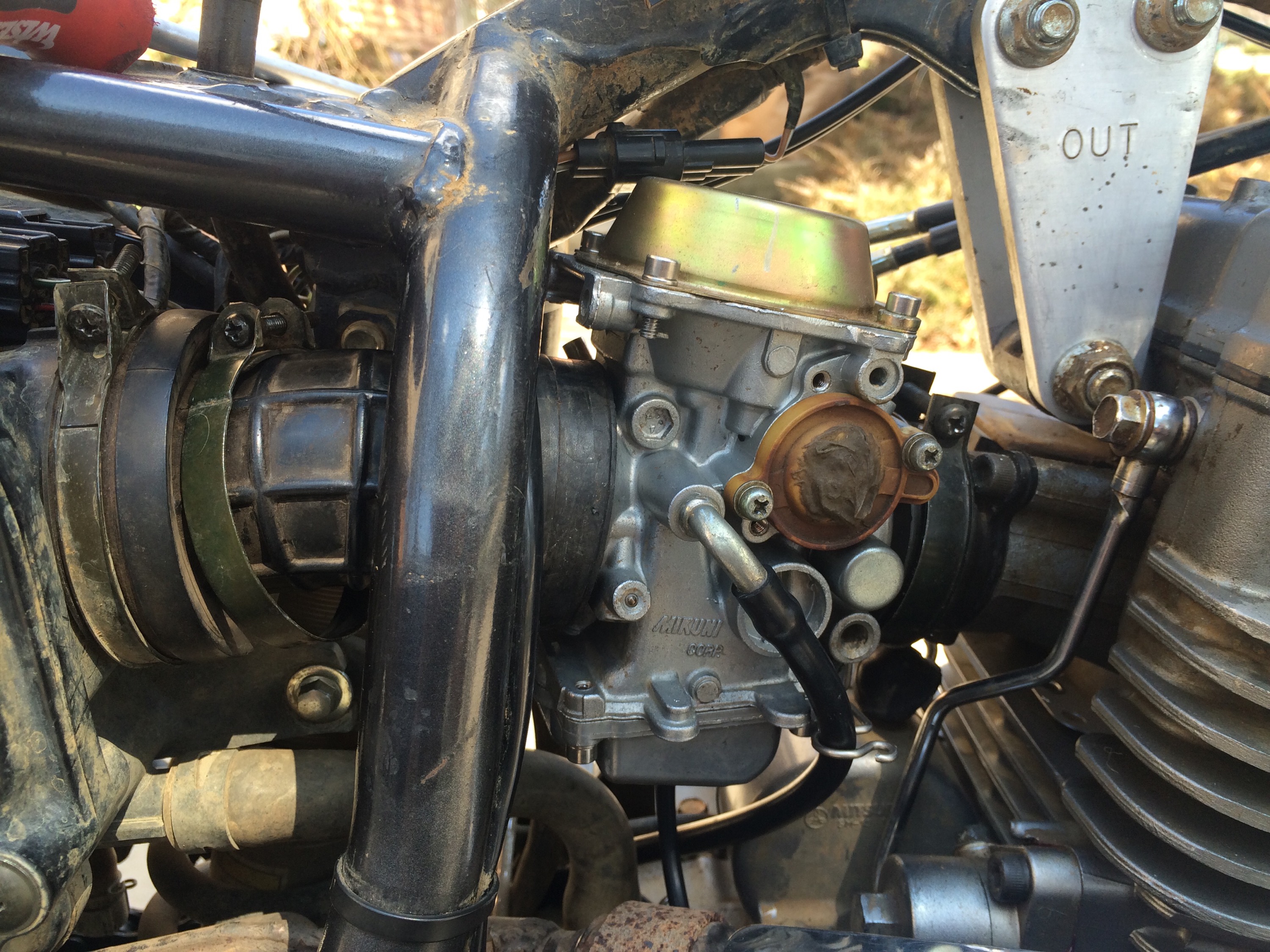
I had to look it up. My new suspension is wallowing. It seems as if the fork springs are too soft when I get up to freeway speeds. Weird.

Time to play with the suspension, I guess. Might have to do a spring swap with the old forks.

Last year, I wrote about getting my lean back. This year, it is about how it gets better.

It’s spring, and from the looks of things, it’s the first, second, third, and many other seasons for riders. It’s the first few seasons that I’m thinking of. Bikes are approached with wonderment, desire, and maybe a bit of fear or concern. Am I going to be able to ride well? So many long-term riders seem to be able to start and stop riding with such ease, will I ever be one of them? Will riding ever come naturally (after a break)?

My first season was short – a month and a half. Then winter break for a month or so. Getting back on was a bit touchy. I had to basically teach myself to ride again. My head got it, but my body didn’t, and that resulted in a lot of confusing signals. It was work.

My next season was my first full one, and it was good. Coming back after winter break was easier, but I still needed some time to equilibrate. My third season was similar – I needed time to get back on my horse, and then my horse decided to die, which caused all sorts of other issues. Namely, the need for a spare horse. Which I then had to acclimate to. The next winter brought a two-and-a-half-month break and a move back to the US. Different land, different rules, different roads. Oof, it was really a challenge to come back. I had lost my lean. I had lost a lot of things. But slowly, it all came back.

This winter’s break was different for some reason. It was longer – three months. I changed my horse up again by swapping out the suspension for some better-fitting kit. I didn’t take a BRC this year. I’d spent the three months dealing with a back injury. I still faced a few jitters about getting back on. Was it going to be iffy again this year?

That’s what I’m here to tell you. It got better. Not just a bit better, but way better. This year, when I hopped on my bike, my body responded without my brain needing to tell it what to do. I had my lean back from the get-go. The onset of riding is better this year, because finally, my body completely gets it. It gets it well enough not to forget it. I was surprised, I admit. My brain needs to do a little catching up, but doggone, my body… So good. So many things that I notice myself doing right, without even considering the situation consciously. Trusting myself is good. Knowing that I finally have the muscle memory down pat is really good.

So if it’s your first or second spring back from break and you’re not 100% sure of yourself, don’t worry. It gets better every time.

This damned 11mm Brembo brake cylinder…..

It seized up again. This time, I knew what was happening, so I was able to address it before it totally went nuts. I was able to recover the white sleeve and do the repair to the main bore without burning through one of my precious and rare rebuild kits.

The critical element is a PTFE sleeve that is 18mm long, 2.5mm wall thickness, 16mm outer diameter, and 11mm inner bore.

Given an endless supply of white sleeves, one could conceivably simply continue to clean out the poorly-designed master cylinder bore quite a few times before it was completely beyond salvage.

I have read many complaints about how difficult it is to remove the carb from the Super Sherpa. Let me help you with that.

To begin with, lift or remove the fuel tank so that you have some room to work. Then remove the rear throttle cable, the front throttle cable, and then the choke cable. Remove most of the hoses from the carb. This will make it easier to remove.

IMG_2181.JPG

Loosen the two hose clamps that hold the intake boots in place and push the rear one to the back of the boot near the airbox.

IMG_2182.JPG

Procure a large flat-bladed screwdriver and insert it into the rear boot, prying it backwards and off of the carb funnel. Push the boot to the middle of the carb funnel.

IMG_2183.JPG

IMG_2184.JPG

Remove the screwdriver and reinsert it from the rear. Lever the boot over the far side of the carb funnel and push the carb toward you.

IMG_2186.JPG

IMG_2187.JPG

The carb will free itself neatly and pop out of the front boot.

IMG_2188.JPG

Pull the carb out of the bike and you are home free. Installation is the reverse of removal.

Every summer, some rider crashes without gear and gets shredded. Pictures get posted. Stories get told. Wounds begin to heal.

I cannot imagine not wearing all of my gear when I get on one of my bikes. I mean, who wouldn’t want to look this cute?

IMG_2134.JPG

I admit, wearing leathers to work is fun(ny). What few other riders there are see me and some shake their heads, others ooooh and aaaaah and tweak me for it, knowing that they would do the same if they actually rode to work. Of course, they probably wouldn’t look like a giant pink and white Peep. The non-riders pretty much scatter, which I don’t get, because I’m hardly intimidating. But maybe it’s not me. Maybe it’s the aggression that leathers in general signify in American culture. Really, though. Pink and white leathers are not aggressive. I promise. It’s only a motorcycle. It’s not going to hurt you as long as it’s off.

Truth is, I have lots of nice, well-fitting, decent-looking gear. The suit above is my riding-while-beautiful suit. It’s not the heaviest-duty suit I own, but it’s a tonne more protection than jeans and a tshirt. It also helps to have nice big side boxes to pack work clothes and shoes into and so on. If you’re a new rider on a little CBR with only a backpack, your options are more limited. And the looks I get when I roll into work in leathers. You’d think aliens had landed. Imagine being a new rider, showing up looking like Bibendum or SpiderMan, and having to answer for it. I’m old enough to just look down my nose over my glasses and say “I like looking this good” and mean it. But I’d hate to go through my first year of riding again and have to answer all those questions again. Especially as a teenager.

No one should ever be ashamed of gearing up or how they look with gear on. It’s a badge, kind of like a scar that you can take off. A reminder to yourself that you want to always be able to take your scars off at will, that none will be permanent. At least, none of the riding scars.

So don’t you want to look cute, too? Go ATTGATT. Wear your leathers. Ride while beautiful.

I’ve babbled quite a bit in the past about my low bike. It’s been so good to me – I’ve never been afraid to ride it or worried about losing it at a stop. Not that I haven’t (I have dumped it a couple of times), but I’ve never worried, because not only could I flatfoot it, there was close to 1.25″ of space under my butt when I stood up over the seat. As I’ve grown as a rider, I’ve become less satisfied with the lowness and realized that I don’t feel super stable at stops because my knees are bent. And standing over the bike isn’t really all that stable either. Add to this that I’ve had some really good experiences on bikes that I was really just barely flatfooting, and I decided to take the plunge and raise my GS to stock normal height.

The FSM bless BMW, they make it easy on a rider who needs to grow into their bike. A four-bit component swap and it’s done and over with, all with stock parts purchased from another bike.

IMG_2040.JPG

Unless you’re an F650GS pro, it’s visually challenging to differentiate between normal and low bikes, but the difference is like going from a cruiser to a standard for me. I had ridden with the optional OEM Dakar seat for a few months – a plush (seriously, it’s the only word to describe this seat) confection that my back just does not love. In fact, I ended up in PT for four months thanks to it. Yuck. Amazing what an inch of foam can do to you. It does not add height, per se, but does open up the ergos a bit. Just enough to freak my body out, apparently. I did like the reduced butt clearance when standing, but found that I sank into the seat quite a bit a when riding, and that just kind of weirded me out. I think seat changes are best left for new-to-me bikes.

I popped the old low seat (recognizable by the tear over the gas tank :grrr:) on and put my leg over. Unsettled, I had one foot down and one ball of the foot down. I wasn’t sure what to expect for settling, but this was not bad at all. In fact, ball of my foot doesn’t really cover it. I had about 1cm tops under my heel, and when I put my touring boots on, that almost disappeared.

I pushed it out into the driveway to warm it up after its all-too-long winter nap, grabbed my gear, and took it out in the neighborhood for a spin. As I rode, I could feel it relaxing into its new normal. I stopped at home to grab my purse and put the boxes on, and then went out for a full shakedown. By the time I got home, it had settled a solid centimeter, and not only are my feet on the ground again, but I have a bit of space under my butt. This is not surprising – it has a very wide seat and due to how humans are shaped, this almost forces a bit of air under there. Two babies did not spread my hips that much! My legs are very slightly bent at stops and nicely extended. I can one foot it with far more grace and ease now. It’s exactly the right height.

My next step with this project will be to start playing with the preload. The preload is at full soft right now, and while it technically does not raise the bike, it does affect the sag. I’m hoping that this shock will have less sag than the short one did, because even at full hard, it sagged quite a bit. Nearly an inch, by my estimation, and with all 135# of me on there (in fat mode), that’s a lot. I know BMW designed this bike for commuting and for smaller riders, but it seems to me that I should not be sagging that much! I will spend some time researching the topic and work to get it dialed in over the summer.

In sum, what was I waiting for? I love this bike to bits, and now it’s really where I need it to be. The ergos are completely unchanged – especially with going back to my low seat – and the height is great. I feel even more comfortable on it. Have I mentioned that I love this bike?!?

I’ve commented in the past about my low GS. It’s now a thing of the past. The low part, not the baby GS part.

Christmas this year brought me one of those über-cool Santa gifts – a set of used normal height stock suspension to replace my stock low suspension with. Fork tubes, center stand, sidestand, and rear shock for the princely sum of $700 from a trusted parts guy. Of course, the fork tubes are US spec, and have the ugly reflectors, but I will live.

What was important to me up front was to understand the various differences between the two suspension sets. On the low setup with preload fully hard, I had close to 1.25″ of space between my butt and the seat when standing over the bike. I never measured sag, but it was at least an inch or so. My knees were bent when sitting at a stop and I felt that I missed some stability due to that. For some reason, I feel more comfortable with my legs extended and less bent when stopped.

First, the centerstand. When modifying suspension up, one needs a stable means of holding the bike up. As the swingarm will have to be moved around a bunch, a centerstand is quite useful. So it is replaced first and the bike pulled up onto it. In my case, the new centerstand is one inch or 25mm longer than the old one. I realize now that this is a terrible picture, but you can get an idea of the difference.

IMG_1942.JPG

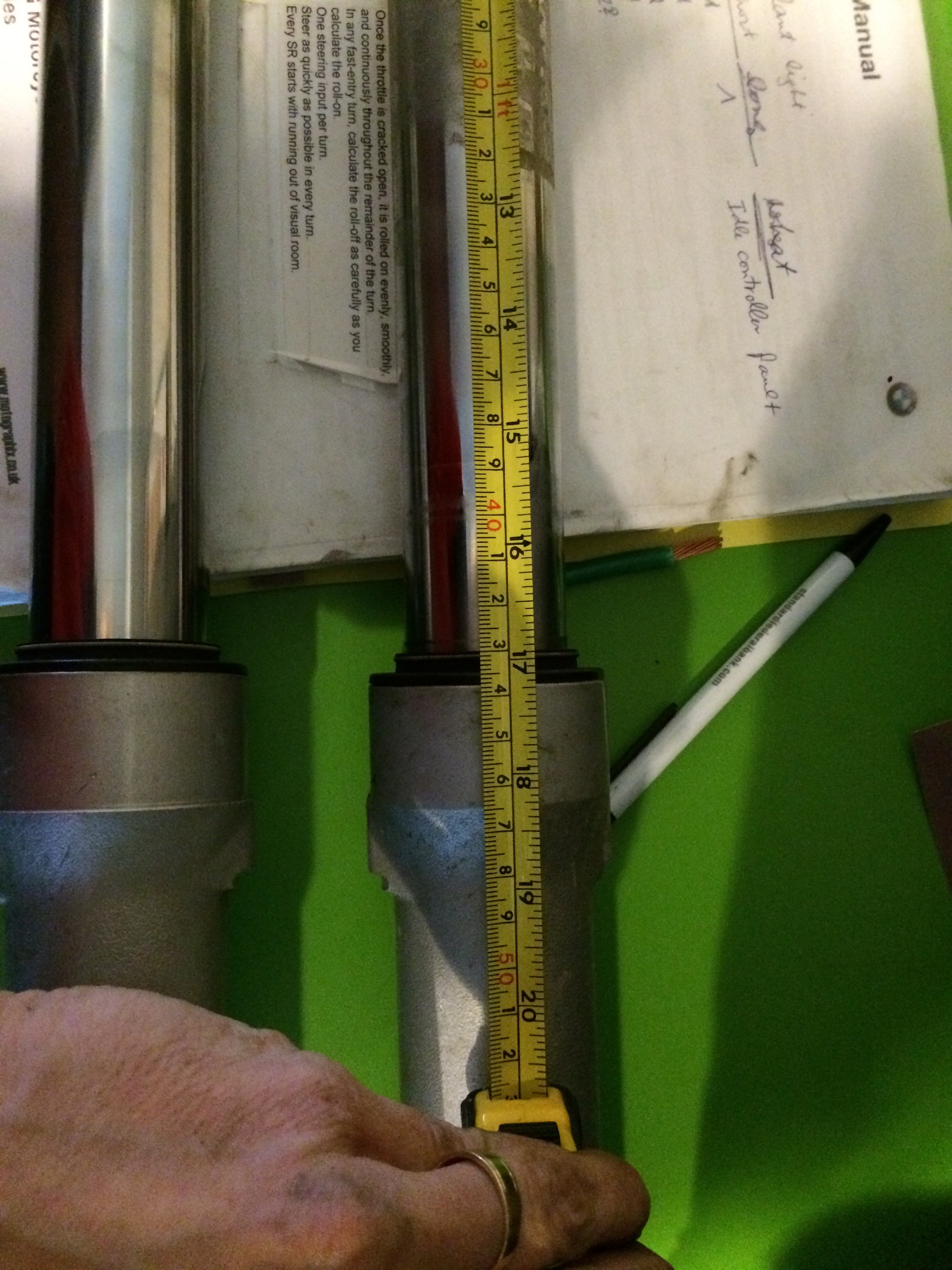
Next are the fork tubes. The fork tubes are also longer by an inch on the slider end. This is effected by using a different size spacer inside of the fork for each set. The actual lowers and sliders (and springs and so on) are all the same. This is actually very cool on BMW’s part because the suspension behaviour does not change very much from low to normal. Once the fork tubes are in, the bike is now at “full” height from centerstand forward.

IMG_1951.JPG

IMG_1955.JPG

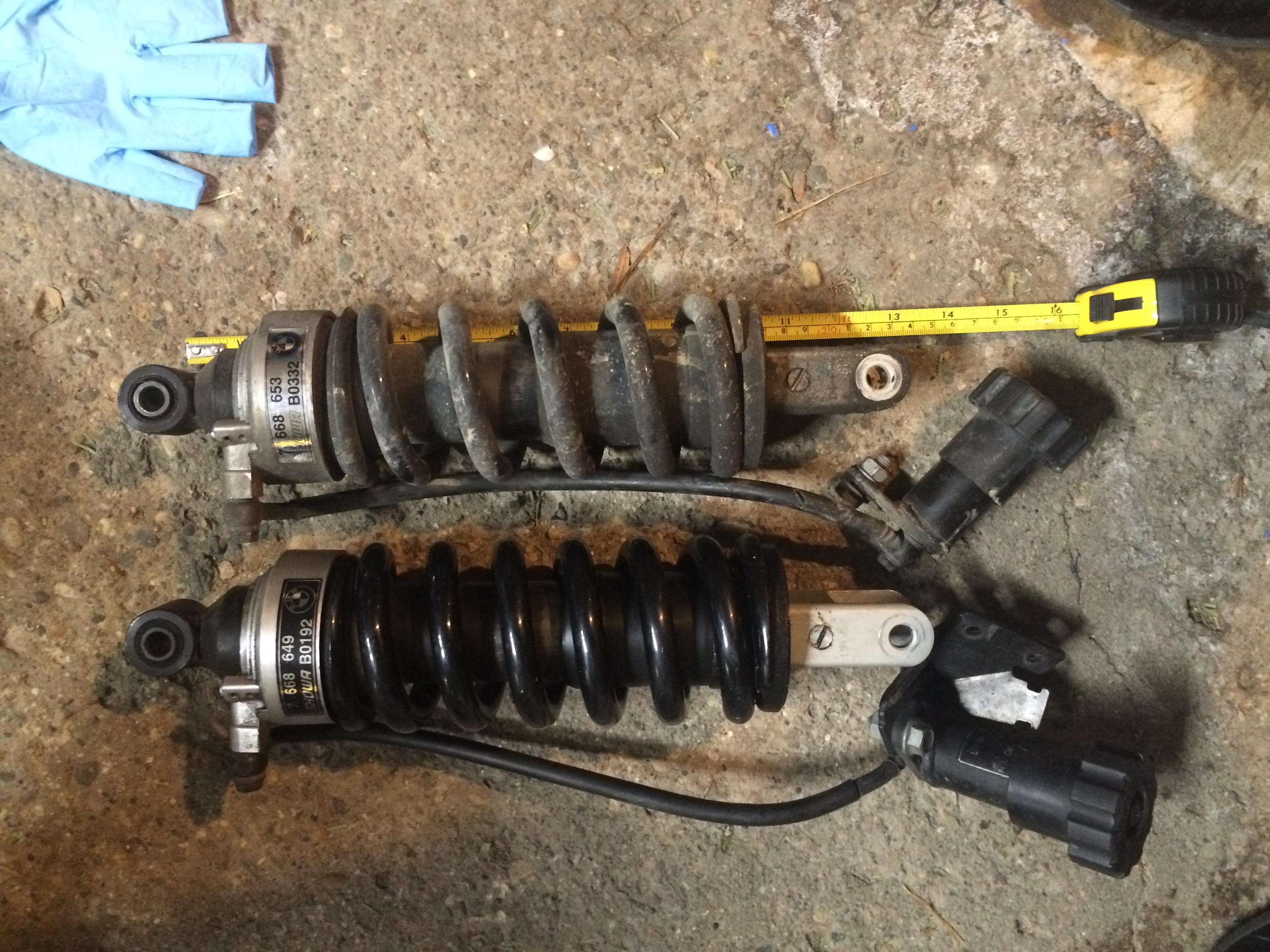
The rear shock exchange requires lifting the rear frame and gas tank. This requires removing the exhaust. I swear, everything substantive on this bike requires removing the exhaust! But it’s relatively easy to do and gives me a chance to clean up any mud or other dirt under there. The shocks are not as different, although too late I realize that the preload settings were completely opposite. I need to let the preload off of the short one and eventually remeasure. The shocks are about 0.5″ different, which results in roughly an inch of difference in the bike due to the geometry of the swingarm.

IMG_2018.JPG

IMG_2021.JPG

Lastly, the sidestand is replaced. What a PITA, BMW. Even with a new bolt, the new sidestand is just as wiggly as the old one. The new switch clip is more interesting to install, also. But on it all goes, and now I can get on and off the bike. The sidestand is also one inch longer.

IMG_2016.JPG

All in all, I think I have about four hours of effort in. The centerstand took about fifteen minutes, the forks about fifteen minutes, the sidestand about a half hour due to fussy springs, and the rear shock took the rest of it, which included much cleaning and scrubbing time. To do it again, I think three hours tops, closer to two.

So, what is the final verdict? Suspension swaps are pretty simple tasks. I’ll write about riding on the new suspension in a separate post. Here’s the result.

IMG_2040.JPG

It’s taken me a while to get my head wrapped around this, but finally, here it is: why the US fails at zipper merges. Surprise, it’s not entirely the fault of our poorly-trained drivers.

I noticed this when I was living in Germany – the zipper merge (all traffic uses both lanes prior to the merge point and lanes take turns merging) is smooth and seamless (ha ha) over there. It just works. In the US, you find two behaviours – either the drivers merge into one lane long before the merge point and drivers are incensed at those who use the free lane, or the drivers use both lanes, but do not take turns. Both behaviours are wrong and at best slow traffic, at worst lead to road rage and/or accidents.

However, I’m not in a hurry to blame America’s drivers for this one. Instead, I’m going to blame our traffic engineers. Let’s have a look at the typical road markings for merge lanes in both the EU and the US. Lane 1 is at the top, and the merging lane is at the bottom.

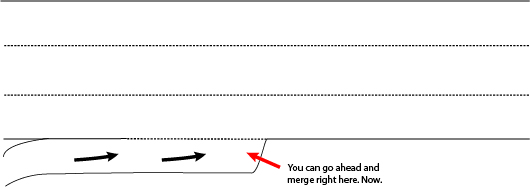
In the EU, well, Germany at least, the merging lane is full-width until the merge point, at which it very abruptly ends. The drivers are reminded to think about merging by a few arrows painted in the lane. The lane reduction zone is usually around 5m long, so not much time to think about it – you just take turns and move on with life. The dotted line between the merging lane and the through lane is usually about five to ten car-lengths long.

Merge_EU

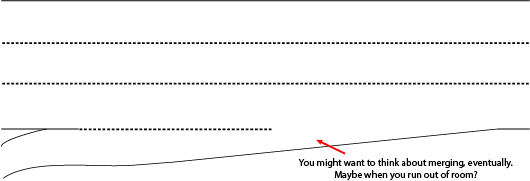
In the US, the merge lane gradually narrows over (usually about) a quarter mile, gently nudging cars over. The dotted line often disappears when the merging lane is less than half of a normal lane width, further complicating the marking. This can create additional confusion about when particular vehicles should actually complete the merge.

Merge_US

The difference between the two is that the EU markings clearly indicate that the lane is ending at a fixed point, while the US markings allow the lane to continue to exist for various lengths depending on vehicle width. This confuses the issue of when exactly to merge, because let’s face it, if you are smart, you don’t merge until you have to. The confusing lane markings mean SUVs have to merge before motorcycles do, and most drivers will posit that that is hardly fair! On the other hand, if you’re one of those early mergers, you don’t even realize that you could use the whole lane, because it disappears in such a tricky manner and you want to avoid that ambiguity at all costs. Which you do by merging early and blocking up traffic for everyone. The worst cases are those drivers who are sadly so confused that they opt to drive in both lanes (halfsies!) and block both of them to forward progress.

Although I’ve drawn the roads as entrance ramps, this exact setup works (in both cases) the same for regular lane reductions due to construction, road use, etc.

The Federal DOT could do us all a favor and modify their guidelines for merge lane markings. The clearer EU setup not only promotes the zipper merge through logical markings, but also subtly discourages lane straddling.  Coupled with a bit of driver education, this change could zip up one of the most annoying road issues we have to face today.