Archives

All posts by atomicalex

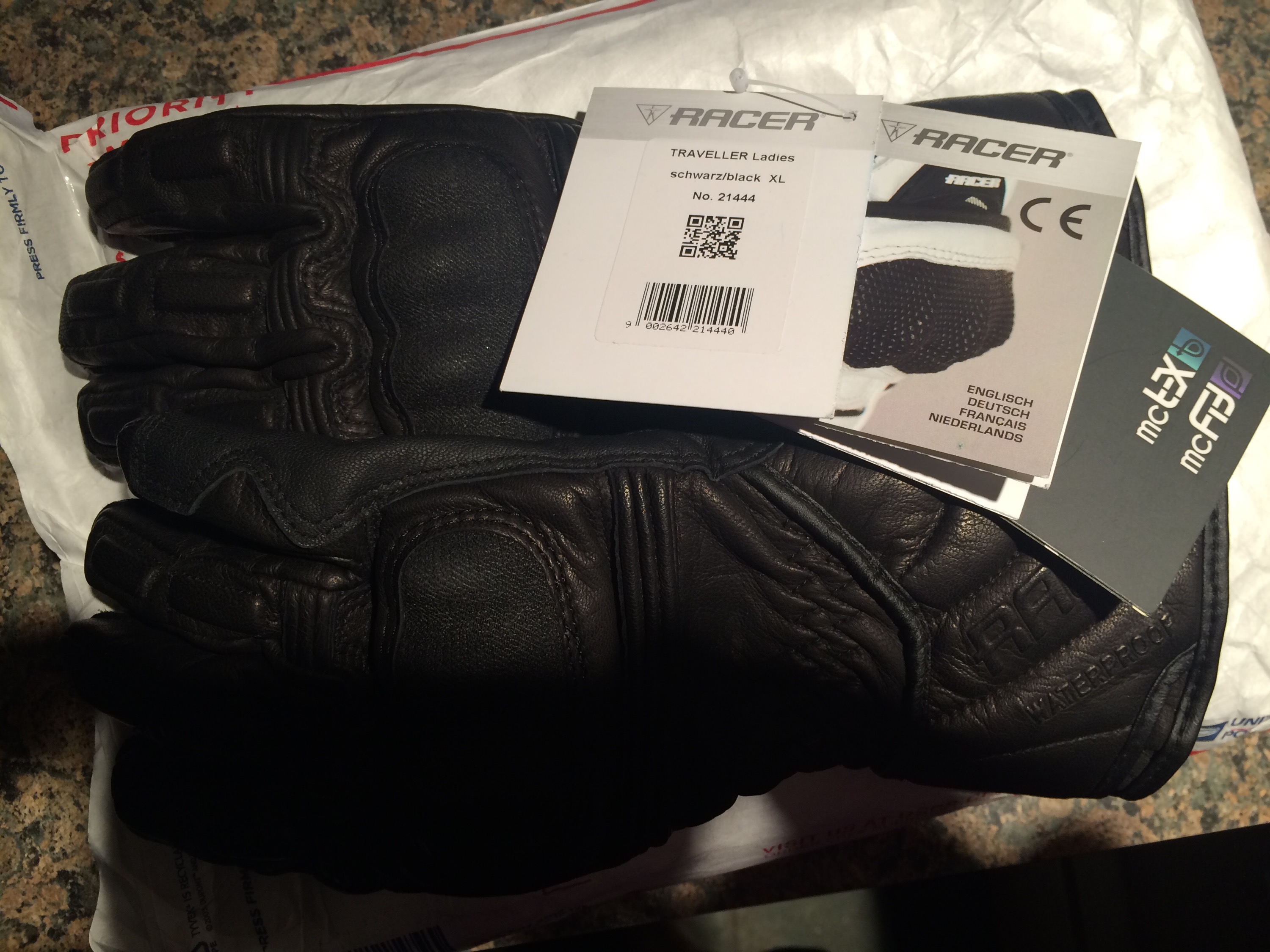
I gave Sean MacDonald over at Lanesplitter a bunch of crap after he went all gooey on a pair of gloves from Racer, an Austrian brand with distribution in the US. He challenged me to actually try the gloves, so I did. After a few emails with the distributor in the US, a great guy named Lee, I ordered a few pair of gloves to try out.

The problem is that I have stupidly long fingers. Not long in the normal sense that I would need size Large gloves, but stupidly long in the sense that I actually only own one pair of glove that really fits, and they were off a clearance rack of gloves that no one else fit into. Length-wise, a men’s 10 or 10.5 is usually the trick. Of course, then I end up with a super wide glove with really bulky fingers. It’s not a good thing, and I generally accept stuffing my fingers into a 9 and hoping I can take breaks.

The gloves from the clearance rack are summer gloves and at first, I thought they were too big. Then I rode with them. Huge revelation. Before that, I’d never worn gloves that fit properly. You know how they say to buy gear you’ll wear? Day after day, I kept putting those $14.99 clearance-rack Speed and Strength gloves on. Ugly, dorky, but damn do they actually fit.

The Racer Traveller DXL (ladies extra large) gloves actually fit pretty well, too. They are bigger in the palm than I need, but not nearly to the extent a men’s glove is, and are long enough that my fingers and thumbs don’t get jammed up. It’s also not a summer glove. Not a proper winter one, but better than any other glove I have that fits when it comes to weather. It’s waterproof and the lining is soft. It has hard knuckle protection, also a step up from anything else I own (that fits). The whole fit thing is a huge issue – joint pain is nothing to mess with and jamming your fingers can lead to cartilage damage. I don’t want to go there.

I’ll be riding with them tomorrow and beyond. I’m pretty stoked.

IMG_3095.JPG

A quick peek at using the lane splitting (or lane sharing) technique to avoid an emergency braking situation and all of the risk it entails.

It’s important to look for the extra space that can open up. Every survival reaction begins with the reduction in visual room, per Keith Code. Looking ahead and seeing the space open up means better, smoother reactions, and more safety. Always.

I get it, TDIgate is a big deal. We have an affected TDI. But truthfully, cars that aren’t EPA-compliant have always existed, and more than a few made it into the US with nary an issue. Here’s the story of the other EPA-non-complaint Volkswagen we have owned.

It was time to buy a second car – we’d both scored good jobs in opposite directions from the house, and one car wasn’t going to work. The old Integra was still running great. I was sure I’d wiped all of those dirty EU thoughts out of my spouse’s head, but he wanted a Golf. Ok, Golf it was. We must have test drove fifteen of them. It was the third generation Golf, not really the high point of the Golf franchise, so I was really disappointed. Soggy suspension, flat seats, plastic everywhere. And that autotragic. Yuck. Every single one of them was a disappointment. Then, one day, we drove a dark green five-door. It was different.

Side note: There was a Nugget Yellow G60 on the lot, too. I was actually in love, but was pretty confident that it would mean the end of my marriage. I didn’t even know anything about G60s back then. Ah, I still dream about that thing….. Black leather interior…. 5MT…. But I digress.

The green five-door was stiffer. It was quicker off the line. The autotragic was less tragic and almost magic. It was super close ratio, very odd in the US. Everything about the car was far closer to what I expected from Volkswagen than any of the other Golfs we drove. Ok, I’ll accept it. But I hemmed and hawed about that yellow G60…. And signed on the Golf.

It was easy to speak well of the car. It delivered like my ’88 Integra did. Everything worked, and what didn’t was repaired or replaced by the dealer. All was well.

About a year into ownership, we got the dreaded red envelope in the mail. The first of two, actually. It mentioned that the transmission in the car was not intended for the US market, instead it was a Swiss market transmission. For mountain climbing. Well, we lived on a small mountain in Philly, so no wonder we liked it. We didn’t have to exchange it, but if we wanted to, the dealer would put in the proper US-spec transmission and we would get better mileage. I laughed, because now I knew for sure that we had a close-ratio automatic as I suspected. It was a substantial upgrade over the normal 4sp box.

A few weeks later, we got the second red envelope, this one with a bit more forceful language in it: the engine was recalled. We were to take it back to the dealer for a new motor. The one we had might not pass US emissions testing, and VW could not guarantee the emission system would work in accordance with US laws. We would only get the full emissions system guarantee if we had the engine replaced, and they would do the entire powertrain for us to be safe. If for any reason, the emissions failed testing at a dealership, the car would have to have the entire powertrain replaced with a US-legal unit at no charge. That letter went into the same file. I learned that at that time, EPA could not force us to do a darn thing. Only safety recalls could be enforced.

The suspension that did not conform to whatever the FMVSS for suspension is was not recalled, although it probably should have been.

It took me several years to ferret out exactly what had happened with the car. It wasn’t until we started hearing the same line from the dealer during service visits: “Sorry Mrs H, but we have to air-freight parts from Germany. Your part numbers aren’t in the US system.” It finally clicked. I queried the parts counter and discovered the parts were indeed Swiss market. What else is wrong with this thing?

Back in the day before VW figured out that the Toyota Production System (TPS or Just-in-Time) really did work, they built cars at Puebla using the campaign model. This was the standard since the time of Henry Ford, so it’s hardly that bad of a model. It’s very efficient. Four hundred cars for the US market in silver with black interiors and 4-speed automatics mated to 2.sl0s. One hundred cars for the German market in Tornado Red with beige interiors and 5MTs mated to 1.8s. And so on. We caught a campaign-switch car, where a few powertrains and running gear assemblies were leftover from a Swiss campaign. This happens when a body is too damaged for use, the paint is bad, any number of problems that force the body off the line after the VIN is stamped on. They were mistakenly married to bodies with VINs designated for US delivery, which got proper US interiors during final assembly, making the problem nearly impossible to spot. This offset affected less than ten cars – I believe about four total.

When the transmission eventually failed (a VW thing), our good relationship with the dealer service and parts team paid off – they were able to source and obtain the exact same transmission. Of course, it took a week to air-freight it from Germany, but who’s counting?

We eventually traded the car in on our first TDI, which has its own interesting tales, too. We did not discuss the outstanding emissions recall.

And that’s the story of the other EPA non-compliant Volkswagen we owned.

So, someone tell me exactly where you go to buy motorcycle boots around here.

It’s time for me to retire another pair of Dainese touring boots, and that means a replacement pair is required. Worn soles, leaky membranes, small perforations, etc. I’ve found several pair that I’d like to try on, but the trying on part is the sticking point. I can’t find a place that either carries them or bothers stocking them. Because, you know, women’s gear isn’t a deal here in the midwest. Or anywhere in the US, as far as I can tell. Which is pretty darn lame because like most women, I want to try things on before I buy them.

I contacted the local internet shop, Sport Bike Track Gear. Great website with a lot of gear on it, but when I asked about visiting the shop, Eric explained that they “don’t really have any women’s gear” in stock at the showroom.

Revzilla suggested that I check my item numbers using their stock checker tool, and I found out that they have exactly one of the five pair I am interested in at their Philly gear boutique. Again, women’s = no stock. This extra sucks because I’ll be in Philly this weekend and I would gladly head over to drop some cash on boots and winter gloves. Maybe even a heated vest. Which they also don’t stock in the boutique. For women. I’m sensing a trend.

What’s missing here is neither place offered to bring the boots in for me by appointment. Sad, because I need boots and whoever can get my feet into them is getting a sale.

CycleGear carries the brands I want, but not the actual boots. The problem there is that I want the high-end styles with GoreTex. Too spendy for the average CG customer, maybe? Regardless, it’s still a dead end, albeit a bit closer to home over near Cleveland.

The Iron Pony is hit or miss depending on what they have bought out lately. And in this case, totally miss. Too bad, I’d enjoy the ride down to Columbus.

The rest of the gear “shops” I’ve found are internet only. Super.

To pull off actually trying on the boots side-by-side, I figure that I will need to drop upwards of $1700 on my credit card to get them all delivered to my doorstep, and then I’ll have to deal with the hassle of shipping the unwanted ones back. Presuming at least one pair is actually wanted. And whoever I order them from will get socked with a bunch of shipping costs.

I suppose I could just price shop to the bitter end and order another pair of Dainese boots that I know will fit and that I will get three years out of. Or I could just put plastic bags in my existing boots for another few months until I can snag a trip back to Germany. Over there, I can simply go downtown to the motorbike corner and *gasp* go across the street if I want to try on more than three or four pair at a time.

American retailers need to get the point – women riders will gladly buy. But they have to stock the gear first. And “available online” is not the same as stocking in store. Sorry.

Rules

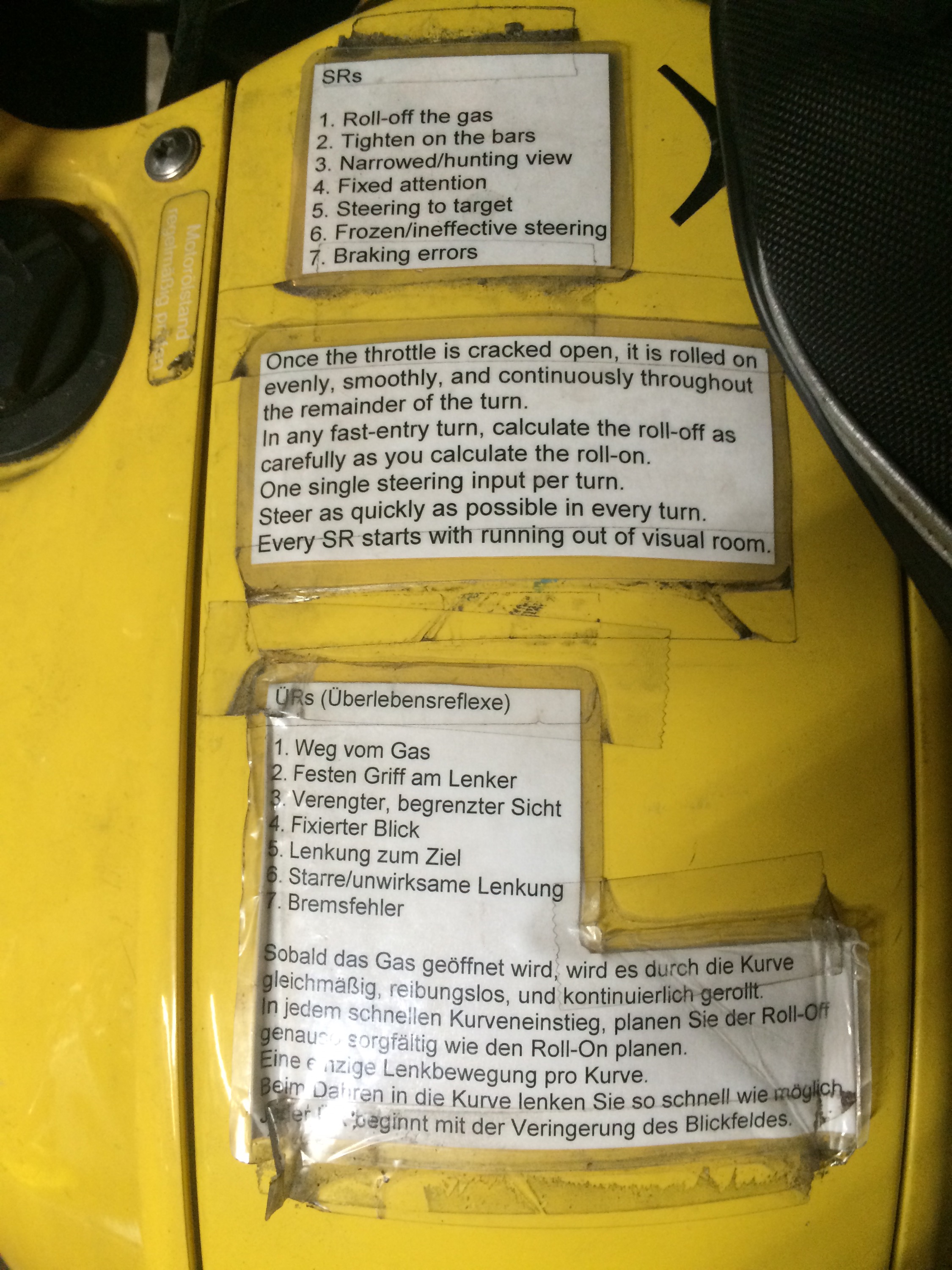
More than a few people have asked me about the scraps of text taped to my fauxtank on the BMW. They are straight outta Keith Code’s A Twist of the Wrist 1 & 2, and in both English and German. Because I learned to ride in Germany, I can get stuck in German sometimes while riding. If everything is going well, English suffices.

Code’s concept is that there are a few mistakes that people make while interacting with their environment (these apply to every form of transit that removes one’s feet from the surface), and by learning to recognize them, we can learn to avoid making them. Additionally, there are a few rules for controlling the motorcycle that can make these mistakes not only less disturbing to the motorcycle, but also less dangerous for the rider. I wish I had read his books early on in my automotive track career.

A pointed note on Rule 1, the most misunderstood sentence in all of motorcycling. “Cracked open” means exactly that. “Rolled on continuously” means exactly that. Not “whacked open” and “whacked open all the way”. The concept of Rule 1 centers on the fact that a very slight amount of throttle angle increase is required to bring the bike back up to speed in the turn and recover from the lean, setting up for launching out of the turn exit. This increase must be made in a manner that does not upset the suspension of the bike. Think of snap oversteer in your favorite rear-engined RWD car. This is an example of upset suspension leading to pain. If the throttle angle is increased in the appropriate manner, the suspension remains composed and the rear tyre remains in tractive contact with the tarmac. It is also good execution of Rule 1 that allows riders to break the rear end loose and maintain control, analogous to drifting one’s car.


Thems the rules. Berndt Spiegel says it’s ok to tape them to your bike, too.

Motorcyclists talk about finding their dream bike. What they don’t talk about is what to do once you’ve found it.

The first time this usually comes up is when someone wants to purchase their first bike. “I’ve been dreaming about a XYZ1000 for years!” People jump all over them saying no, get a little bike, a starter bike. “But then I’ll just have to get the one I want later!” new person wails.

Well, that’s kind of the point. Getting another one,  I mean. I have some experience with that.

I accidentally bought my long-term bike on the first try. It’s a great bike. It was great from day one. I fell for it hard and it’s not losing any charm or fun or anything. I have a bike that I love and fits me like a glove in every way. I don’t know that there actually is a better bike for me. So what? Well, the main problem is that I’m stuck with it. That’s an overly depressing way of looking at it, but it’s accurate. And it means that I miss out on one of the most fun parts of riding – riding all of the bikes. In fact, the only times I have managed to buy other bikes are when my long-term bike was not running. And once it was, I was right back in the saddle. I can’t stay away.

When people say “don’t buy your dream bike right out of the gate,” they mean don’t limit yourself, motorcycle-wise.

It also means don’t assume that what you want before you start riding is what you are going to want after you start riding.

I had some conflicting wants – I wanted to ride a BMW, but I wanted to look at sport bikes. I love how sport bikes look and ride. Standards are fun (the old R65 I want is a standard), but I don’t desire them like I desire sport bikes. Then I started riding, and discovered dual sports. Oops. As much as I love sport bikes and my CBR250R was illegal levels of fun and MV Agusta exists, nothing says “let’s go hoon!” like a dual sport. Nothing says “any time is the right time” like a dual sport. And, of course, nothing says “comfy and loaded” like a BMW. So naturally logic won out and I went out and bought myself a BMW dual sport right out of the gate. Oops.

dragon_1

Now I’m stuck. I want to try all the bikes, but it’s hard to justify it when I’ve got my right bike right here at hand already. Even worse is that now my dream bike is another one just like it, except in black. That’s right – two of them. Gotta match my outfits, you know. I still think about other bikes (I do want to collect an R65 one of these days), but none of them match up to my baby GS very favorably when it gets down to spending money. It’s a downer, I tell you. I think I need to go ride and shake it off.

So if someone suggests that you hold off on your dream bike, take them seriously. Ride all of the other bikes first. Because if it really is your dream bike, you’ll never want to ride anything else, and you’ll miss out on some good motorcycling fun.

Germany has a rule-based culture, and a fair chunk of life is spent figuring out how to get around the rules while still obeying them. Spirit vs letter of the law. In the US, we prize the Spirit of the Law. In Germany, it is the Letter of the Law. Once I figured this out, my life in Germany got to be fantastically easy. Just figure out how to get around the rule while creatively applying it, and you are fine. VW’s emissions control defeat programming would put the cars in compliance with the Letter of the Law, which specifies the testing conditions, while violating the Spirit of the Law, which says “don’t pollute”. 

I am totally guilty of this, and I think the statute of limitations is up by now.

My wonderful MkIII Golf GT TDI (up top there) was not really in compliance with anything. It was low. It was leaky. Very leaky. And it sort of stopped. However, it was only a few hours of work away from passing the TÜV.  Just like every other modified car in Germany – I had a procedure to get my car ready.

This is what it took:

  1. Porous head gasket. Several cans (ok, close to a case) of engine cleaner, a lot of rags, and two toilet brushes. Over the course of several hours, I removed enough oil and coolant residue to power a small nation. I also ran the coolant mixture down to about 10% glycol. Arrive at testing station just in time so car is hot.
  2. Badly worn summer tyres. Swap on winter wheels with good snows. Same thing if I was running too-large wheels, but I wasn’t.
  3. Lame brake pads. While I was in there swapping wheels, pull off all of the calipers and rough up pads and rotors.
  4. Barely clearing the 10cm bar. Leave car up on jackstands for 24 hours and drive gently to testing station. Bring certification letters for suspension with me with setup that passes circled. I had considered removing the front valance, but this risked failing the obviousness test.

When I arrived at the testing station, the car was solidly at 11cm and my coil count matched the paperwork. Braking was acceptable. I got some dirty looks for my snow tyres because it was May. I earned a comment on how clean the engine was. I noted it and realized that I should have cleaned it a week earlier to look less obvious. And the emissions check was thankfully in spec with no weirdness.

I failed on a broken reflector lens.

When I went back two weeks later, the lens was all they could check. So my clearly leaking (it was dripping) and obviously too low Golf was cleared for driving, because I passed the test as it was written.

I feel kind of funny saying this, but the “pass the test as written” is a cultural thing. With regard to #Dieselgate, I am willing to bet all of Internal Combustion knew exactly what was up and didn’t really think it was that big of a deal, because they passed the test. Oops.

I just read another useless listicle about how to survive high heels. Urgh.

There is one and only one “secret” to a comfortable pair of heels (other than the “secrets” that apply to all shoewear selection) and that is heel pitch.

It’s not even a secret, you can see it right there in front of you. Just look at your shoe and find the top line of the heel where it meets the body of the shoe. I put a pink line on the image to show you where it is.

heel pitch

Now that you know what heel pitch is, you can use it. See how the pink line intersects the forward sole of the shoe between the ball of the foot and the toe? That is good. That means that some of your weight will be borne by the heel. Lower heel pitch allows for a more even weight split between the heel and ball of the foot. When the line is steeper, you bear more weight on the ball of your foot. That is not good for all-day comfort. It is also not good for walking – as the heel bears little weight in a steep shoe, it is difficult to walk normally. If the shoe is designed for the heel to bear weight, you will be able to walk more normally and plunk that heel down with confidence.

The only thing you need to check the heel pitch before buying a pair of shoes is a straight line to hold the shoe up to – the edge of the shoe box works great. Line it up with the top of the heel and see where it intersects the sole. Forward of the ball of the foot is better – you will be more comfortable and wear and enjoy your new shoes more.